Get Full Government Meeting Transcripts, Videos, & Alerts Forever!
Get email alerts on the Transportation topic
No spam. Unsubscribe anytime.
Nashville DOT consultant outlines Porter Road traffic‑calming final design and says staff will bypass resident ballot to speed construction
Summary
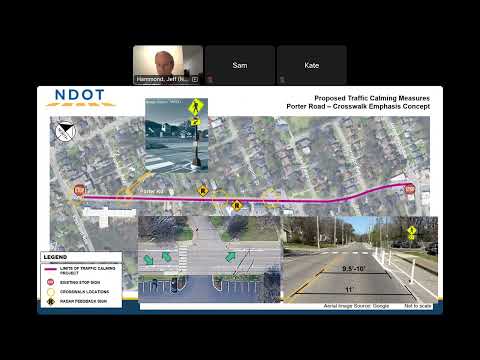
Consultant Jeff Hammond presented a final design for the Porter Road traffic‑calming project that removes speed cushions in favor of lane narrowing, delineators, mid‑corridor radar feedback signs and a rapid‑flash beacon at Franklin Avenue; staff said they will not run an online resident ballot and will move the project into the construction queue, though a firm start date was not given.
Jeff Hammond, a consultant for the Nashville Department of Transportation, presented the final design for the Porter Road traffic‑calming project on Tuesday evening, saying the plan will forgo vertical speed cushions in favor of narrower lanes, delineators, radar feedback signs and a rapid‑flash pedestrian beacon at Franklin Avenue.
"We have a prevailing speed of 37 miles per hour," Hammond said, and added that daily volume is just under the DOT's 5,000 vehicles‑per‑day threshold that typically triggers speed cushions. "Because there's really no speed cushions, we don't ballot these projects," he said, explaining the recommendation to move the design into the construction queue rather than open an online ballot.
The nut graf: the proposed design narrows travel lanes from about 11 feet to roughly 9.5–10 feet using a one‑foot buffer, preserves transit operations and adds features intended to improve pedestrian safety at key crosswalks. Hammond described the Franklin Avenue crossing—near a Montessori school and local businesses—as a priority and proposed a push‑button rapid‑flash beacon there; the Benjamin Street crosswalk would receive additional pavement markings and the corridor would keep radar feedback speed signs.
Hammond said the project spans roughly a half mile and that the design and striping plans will be posted on the city's Engage Nashville site. He emphasized the plan reflects public input collected during two earlier meetings and that the design team adjusted the concept after neighbors questioned whether speed cushions were appropriate for Porter Road.
On next steps, Hammond said Nashville DOT can either contract the work or perform it with in‑house crews. "In this case, the improvements that we are proposing, in theory, could be done in house by DOT crews," he said, noting that in‑house installation of striping, delineators and radar signs could shorten the schedule. He also cautioned that he could not provide a firm construction start date: "I don't have a real solid time frame on that," Hammond said, while adding that projects that go through the normal ballot process typically enter construction about four to six months after the ballot.
A resident asked, "What's the timeline look like for the construction with the proposed changes?" Hammond reiterated the possibility of quicker work if DOT crews perform the installations but declined to commit to a specific date.
There was no formal motion or recorded vote during the meeting; staff presented the recommendation to bypass the resident ballot because the final design does not include vertical traffic calming devices and stated that the department will move forward with implementation planning and the construction queue. The department encouraged ongoing feedback via the Engage Nashville project page.
The meeting closed after a brief question‑and‑answer exchange and a reminder that detailed design plans would be available online for residents and contractors.