Get Full Government Meeting Transcripts, Videos, & Alerts Forever!
Get email alerts on the Traffic Calming topic
No spam. Unsubscribe anytime.
Metro Nashville staff present draft traffic-calming plan for Holt Hills Road as residents cite speeding and cut-through traffic
Summary
Metro Nashville presented a draft traffic-calming concept for Holt Hills Road — three speed cushions, bulb-outs and a ‘slow, safer shoulder’ — after staff reported an 85th-percentile speed of 37 mph and roughly 1,500 vehicles per day; residents urged solutions for speeding, cut-throughs tied to Nolensville-area growth and intersection safety. Balloting of vertical measures requires two-thirds (66%) of respondents to approve.
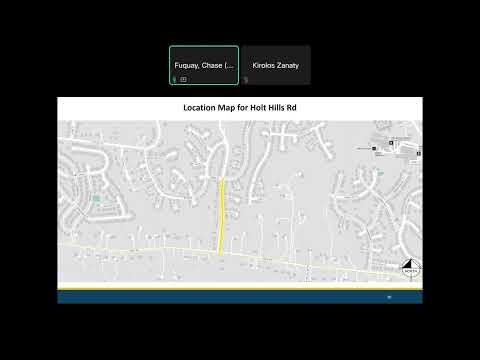
Metro Nashville staff presented a preliminary traffic-calming plan for Holt Hills Road on a project stretch between Cobble Street and Holt Road and invited neighborhood feedback on design options and next steps.
Staff member said data collected earlier in the year showed an 85th-percentile speed of 37 miles per hour on the corridor, traffic volumes near 1,500 vehicles per day and a roadway width of about 36–37 feet. "It's 37 miles an hour," the staff member said while reviewing the speed data and explaining that the program emphasizes physical measures that reduce speeds.
The draft concept shown at the meeting includes a bulb-out at Cobble Street, three evenly spaced speed cushions (staff noted cushions are often spaced roughly 300 feet apart with the last cushion about 200 feet from the Holt Road stop), and a "slow, safer shoulder" on the south side with an edge line on the opposite side to narrow travel lanes while retaining parking on one side. Staff described speed cushions as a preferred vertical measure because they are widely used and allow emergency vehicles to pass through the gaps, and said radar speed-feedback signs, lane-striping and modular rubber curbs are additional tools under consideration.
Residents raised multiple concerns during the meeting. Several described persistent speeding and near-miss incidents during morning walking times; one resident said a driver "had to be" unable to stop when someone tried to back out of a driveway. Another attendee framed the problem more broadly: "the root cause of almost everything is the volume," the resident said, noting that growth around Nolensville Road has increased cut-through traffic on neighborhood streets. Attendees also described frequent roll-throughs at a local four-way stop and issues for delivery trucks and school buses.
Discussion at the meeting weighed treatment trade-offs: plastic delineators and painted narrowings can provide visual cues to slow drivers with minimal loss of parking, while vertical measures such as cushions are harder to ignore and typically reduce speeds more. Several residents suggested considering compact roundabouts or raised intersection islands as alternatives to cushions or delineators at larger or problematic junctions.
Staff outlined the project process: after collecting feedback at this first neighborhood meeting the project team will perform field measurements, refine the concept, then return with a more detailed draft design at a second neighborhood meeting. If the design includes vertical measures (speed cushions), the program sends a unique mailer to eligible properties abutting the right-of-way and opens an online ballot for six weeks; staff said that if 66% of respondents vote yes on the vertical measures, the design moves forward into the construction queue. The parcel viewer is used to determine the mailing list, residential parcels and abutting properties receive a ballot, and vacant parcels are ineligible; staff said the owner list is refreshed before mailings so ballots go to the recorded owner at the time of mailing.
Staff asked attendees for additional input on specific treatments (for example, whether to use delineators or speed bumps at bulb-outs and how to design slow, safer shoulders around driveways) and invited people to submit comments through engage.nashville.gov/trafficcalming or the QR code on the slide. The team said it will present refined design options at a future meeting and post materials online before balloting.