Get Full Government Meeting Transcripts, Videos, & Alerts Forever!
Get email alerts on the Stormwater Program topic
No spam. Unsubscribe anytime.
Palmetto Bay considers stormwater fee, expanded tree‑planting and LDC changes to reduce flooding and grow canopy
Summary
Consultants and the vice mayor presented two funding scenarios that would expand tree planting and green infrastructure paid largely from the stormwater utility; council members asked for more detailed cost, staffing and drainage analysis before approving code changes or a rate increase.
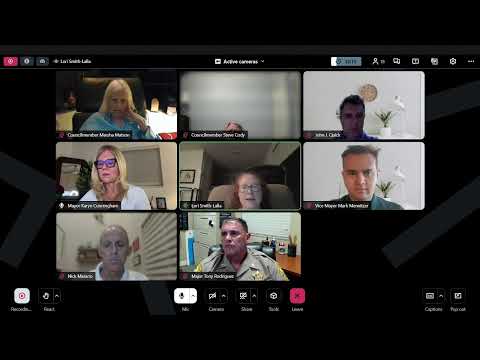
Palmetto Bay officials on July 14 heard a two‑part briefing on plans to expand urban tree canopy and green infrastructure funded through the village stormwater utility and new land‑development standards.
Consultants from Raftelis laid out two five‑year scenarios for a shading and green‑infrastructure program. Hannah Palmer Dwore, senior consultant, said the "basic" scenario would add roughly 460 trees over five years while a more ambitious "advanced" scenario would accelerate planting and staffing to reach a substantially higher five‑year total. The consultants framed costs around crews, equipment and maintenance rather than a simple dollars‑per‑tree calculation and said assumed unit costs included $300 per tree for village installation, $175 for private installation and $20 per tree per year for maintenance. They also reported contractor budgets of about $40,000 per year (basic) and $50,000 per year (advanced), and an ERU (equivalent residential unit) range being discussed in the rate study of roughly $10–$12 (basic) and $11–$13 (advanced).
"This is not a repackaging of the current program, but rather an additional investment to accelerate shade and village resilience," said Marielle Gensler, the village stormwater engineer.
Vice Mayor Mark Meritzer presented a connected policy package that he said would move Palmetto Bay from a "pipes‑only" approach to one that treats rain where it falls. His proposal includes (1) a stormwater ordinance to authorize green infrastructure, urban forestry and outfall retrofits; (2) a pilot "Palmetto Bay Beautiful" grant program to make it easier for private property owners to install trees, rain gardens and other features at a lower negotiated cost; and (3) targeted land‑development code (LDC) updates that would apply prospectively to new permits and scale requirements to project size. Key LDC elements described included increased parking‑lot shading (ramping from one tree per eight spaces toward one per five over time), requiring new commercial redevelopment to retain a rising rainfall depth on‑site, reducing the maximum turf area on large redevelopment projects to 40%, and replacing removed trees by canopy area rather than simple tree count.
Meritzer said the approach is meant to be incremental: the grant pilot would start small, the LDC changes would be prospective and grandfather existing properties, and the stormwater rate study (to be presented July 20) will define the revenue needed to implement the selected scenario. "Infrastructure will never get cheaper," Meritzer said. "Every year that we wait, the cost of doing this goes up, and the cost of doing nothing becomes even more expensive."
Several council members praised the goals but sought more detail. Council member Steve Cody urged additional analysis and cautioned against adopting ordinance language or policy direction without a budget, a staffing plan, geotechnical or drainage‑based performance targets and measurable pilot criteria. "Urgency is not a substitute for analysis," Cody said, adding that statewide tree interception statistics do not show how much flooding the package would prevent in Palmetto Bay or the cost per gallon avoided.
Village staff and directors told the council an additional certified arborist or similar staffer is likely required to implement LDC compliance and that some general‑fund costs (legal review, administration) would accompany stormwater‑funded planting and grants. Administrative presenters also confirmed they will refine cost estimates and that the LDC changes are not intended to take effect until after state constraints (cited as Senate Bill 180 timing) and additional internal review; Meritzer said the aim is to bring a final item for first reading in September and adoption in the fall budget cycle.
What happens next: staff will finalize the stormwater rate study (scheduled July 20), refine the program budget and staffing implications, and return the policy and ordinance package to the council for formal consideration. The council did not vote on any ordinance or rate increase at Tuesday's meeting.
Ending: The presentation closed with direction to continue work on the rate study and program details; council members broadly supported the goals but asked staff and the sponsor to provide the technical, fiscal and measurable pilot criteria they said are necessary before formal adoption.