Get Full Government Meeting Transcripts, Videos, & Alerts Forever!
Get email alerts on the T1 Zone Buffer Change topic
No spam. Unsubscribe anytime.
Residents press commission to retain 150‑foot buffer as T1 zoning changes draw public concern
Summary
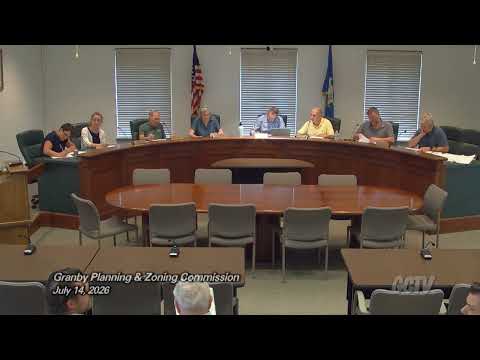
At a crowded July 14 hearing in Granby, residents urged the Planning & Zoning Commission not to reduce the T1 landscape buffer from 150 to 100 feet for multifamily uses; commissioners left the hearing open for further staff analysis and additional public comment.
Dozens of residents and stakeholders pressed the Granby Planning & Zoning Commission on July 14 to maintain a 150‑foot landscape buffer between multifamily development in the T1 neighborhood/commercial transition zone and nearby single‑family homes.
Selective Development Companies’ representative Ben Hale presented a package of five text changes (File Z‑2‑26) to clarify multifamily design and site standards in the town’s T1 zone. Among the proposals was a provision specifically reducing the required landscape buffer from 150 feet to 100 feet for multifamily uses; Hale said the edit recognizes residential uses have lower impacts than commercial uses and that in some areas—north of Canton Road extension—a 50‑foot right‑of‑way plus the proposed 100‑foot buffer results in roughly the same separation as the current 150 feet.
"We believe that a 100 foot landscape buffer still really meaningfully separates the neighboring single family homes from T1 zone," Hale said during his presentation. Abby Kenyon, staff, explained how the change would interact with other sections and noted the commission retains discretion through the special‑permit review.
Public commenters, including Benjamin Perrin and Richard Saunders, urged retention of the 150‑foot buffer, citing concerns about increased noise, loss of the T1 zone’s intended mixed‑use character, and the precedent a reduction would set for other portions of T1. "This is a significant reduction," Perrin said, asking whether the amendment was driven by a developer request to maximize a five‑acre parcel.
Commissioners discussed alternatives such as making buffer reductions situational (available under special‑permit criteria), clarifying how GIS buffer tools draw arcs, and lowering the traffic‑study threshold (applicant had proposed a 50‑unit traffic‑analysis threshold; some commissioners suggested 20). Marty Schwager, representing the development commission, urged a measured approach and said broader, holistic T1 revisions are already under consideration.
Given the volume of public comment and several technical questions raised by commissioners, staff and the commission agreed to keep the public hearing open and bring additional materials—previous draft criteria, buffer mapping, and staff memos—to the next meeting for further deliberation.
The commission did not vote on the T1 text changes at the July 14 meeting; the hearing remains open.