Get Full Government Meeting Transcripts, Videos, & Alerts Forever!
Get email alerts on the Transportation Projects topic
No spam. Unsubscribe anytime.
UDOT outlines alternatives and timeline for US‑89/I‑84 interchange; railroad approvals could push completion to 2031
Summary
UDOT officials told the Weber County Commission they favor building the full US‑89/I‑84 interchange now using a progressive design‑build delivery, citing railroad permitting and large flyover structures as the principal schedule risks; initial funding is $250 million covering early phases, with a final cost reconciliation planned this fall.
UDOT project staff presented proposed redesign options for the US‑89/I‑84 interchange to the Weber County Commission on July 13, saying the agency recommends delivering the full interchange now rather than phasing construction.
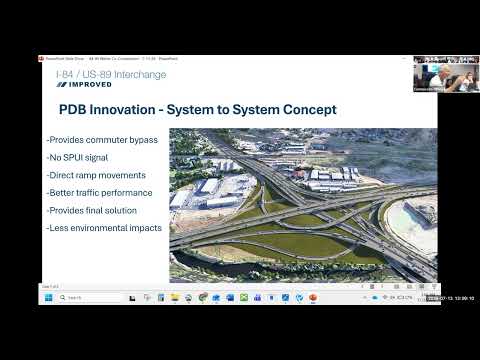
The presentation described three main alternatives: the environmental “West Bypass,” an “outside bypass” that keeps northbound and southbound traffic on their respective sides to reduce footprint and steep grades, and a system‑to‑system interchange that would eliminate the existing signal and provide direct connect ramps. Brady Roberts, UDOT project manager, said the system‑to‑system option is roughly 35–50% more efficient in traffic performance than a SPUI and would provide a long‑term alternative to I‑15 in the event of major incidents.
Roberts said UDOT selected a progressive design‑build delivery to keep contractor and designer input early, a choice driven by expected complexity with Union Pacific (UP) railroad structures, large flyover geometry, and maintenance‑of‑traffic needs. He warned that UP agreements are on the project’s critical path: the UP process for approvals and agreements can take about two years, a factor that likely pushes the full project schedule into 2031 even though non‑rail work could finish earlier.
Commissioners pressed staff on right‑of‑way and acquisitions. UDOT stated acquisitions will be less than earlier environmental documents indicated — noting one house and portions of some commercial parcels (including billboard relocations) remain in the plan — and confirmed new railroad structures will be built offline and switched into service to minimize traffic disruption.
On funding, staff said the program currently shows $250 million assigned (initially for phases 1–2) and that a cost reconciliation with the contractor is planned in November, with an anticipated commission agenda item in December or early next year. Roberts and consultants said phasing the project risked significant opening‑day congestion and that proceeding with the full scope now avoids repeated disruptions and likely provides better long‑term value.
UDOT also said the project will include an off‑road trail component in the South Weaver/Skyline corridor and that project teams are meeting with affected cities, property owners and businesses ahead of more extensive public outreach.
The commission did not take a formal vote on the interchange at the work session; staff said they would return with refined costs and schedule milestones after the November cost reconciliation and continued coordination with Union Pacific.