Get Full Government Meeting Transcripts, Videos, & Alerts Forever!
Get email alerts on the Economic Impact topic
No spam. Unsubscribe anytime.
Cochise County supervisors told a 400‑MW solar-plus-storage example would produce roughly $1 million a year in county personal property tax revenue
Summary
At a July 13 work session, county officials heard a hypothetical fiscal analysis showing a 400‑megawatt solar project with 4‑hour batteries could yield about $1 million per year in personal property tax revenue for Cochise County; supervisors pressed presenters on property values, who benefits locally and battery safety and asked for follow-up studies and negotiation of community benefits.
Cochise County supervisors on July 13 reviewed a hypothetical fiscal analysis showing a large solar‑plus‑storage project could deliver construction activity and long‑term personal property tax revenue, but not necessarily the large near‑term county windfall some board members had expected.
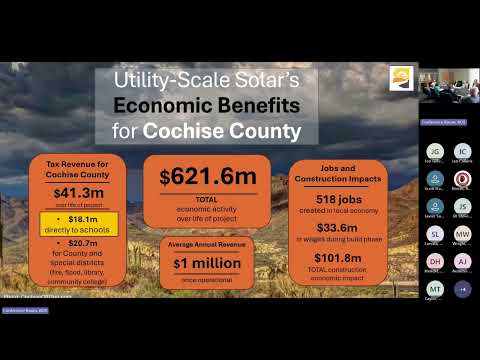
"Projects like this do actually generate benefits in two primary ways," said Jill Stevenson, the consultant who led the county’s hypothetical analysis, describing construction‑period economic activity and longer‑term personal property taxes on solar and battery equipment. Stevenson told the board the example used in the report was a 400‑megawatt solar array paired with 400 megawatts of four‑hour battery storage spread over about 2,400 acres and that the study’s taxable original cost estimate was approximately $874,800,000. After statutory adjustments, she said, that scenario equates to roughly $41.3 million in personal property tax revenue over the study period—about $1 million a year on average.
The presentation spurred detailed questions from supervisors about where the money would actually land. "I want to know what is the county gonna get?" Chairman Antinori said, asking presenters to break the revenue out between the county general fund and independent taxing districts such as flood, library and community college districts. Presenters said the analysis used district‑average rates because the study was hypothetical and did not model site‑specific real property tax changes that can follow a land‑use change.
Supervisors repeatedly raised concerns that most construction work for large solar projects is done by firms based outside Cochise County—reducing local wage and vendor benefits—and that retail sales tax revenue depends on where electricity is consumed. Jason, a representative of Sulphur Springs Electric Cooperative, explained that sales tax is collected at the retail meter and that locally consumed generation can help lower blended retail bills: "We're able to get that in the basket of generation goods for somewhere around $0.02 per kilowatt hour," he said, arguing that keeping load in‑county is a key way to capture local benefits.
Board members also pressed whether the analysis considered property values for homes adjacent to large arrays. Stevenson said the study did not directly model adjacent‑home value impacts and that prior research has not established a consistent, direct devaluation effect but that the team could follow up with jurisdiction‑specific analysis.
Safety and compatibility questions surfaced as well. Supervisor Krasner and others asked about battery fires, contamination and the effectiveness of containment barriers; industry presenters said they could provide separate battery‑safety resources and noted several jurisdictions are developing battery‑specific ordinances. Presenters also recommended early engagement with the U.S. Department of Defense after a port/DOD representative noted the Fort’s electronic testing range covers a broad area and had asked for mitigation planning to avoid interference with unmanned aerial systems.
Presenters emphasized the statutory mechanics that drive taxable values: the model deducted federal investment tax credits (the team used a 30% ITC assumption for the example) before applying Arizona Revised Statute 42‑14155 personal property rules, which currently include an 80% reduction and a 20% depreciation allowance (the 20% deduction is scheduled to expire at the end of 2040). Presenters said those features have a large effect on long‑term revenue estimates and that if the ITC were removed the taxable base would be roughly 30% higher.
Supervisors concluded the session by asking staff and the presenters for more granular information: a district‑level revenue breakout, whether existing local projects are being assessed in a consistent tax class, focused analysis on homes directly adjacent to proposed arrays, more detail on battery safety and a mitigation plan template for DoD‑adjacent projects. The board asked staff to schedule another work session so members can weigh code, development‑agreement and potential community benefit or PILOT (payment in lieu of taxes) tools before any ordinance or project approvals.
The work session did not include public comment or a vote; the board intends to continue the technical and policy review at a future meeting.