Get Full Government Meeting Transcripts, Videos, & Alerts Forever!
Get email alerts on the Housing topic
No spam. Unsubscribe anytime.
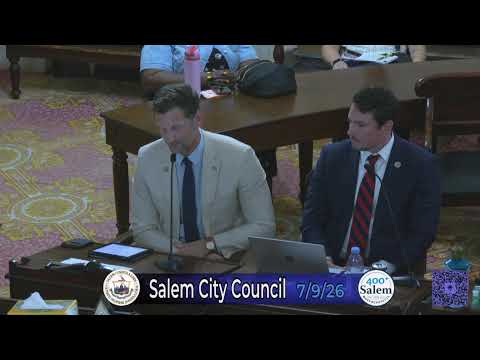
Salem council urges state to lift ban on rent stabilization, adopts resolution 9–2 after extended debate
Summary
After hours of public testimony and council debate, the Salem City Council passed, 9–2, a resolution urging the Massachusetts legislature to lift the ban on rent stabilization and enable local options. The measure was amended to refer to a Consumer Price Index formula rather than a fixed 5% cap.
The Salem City Council voted 9–2 on July 9, 2026 to adopt a resolution urging the state legislature to lift a statewide ban on rent stabilization and to enable cities and towns to consider local stabilization measures.
The resolution came to the council after a Committee on Community & Economic Development hearing that included a presentation from Homes for All Massachusetts and extensive public testimony. Speakers at the meeting urged council support for tenant protections and additional tools to address rising rents; several public commenters described personal and community impacts. "We gathered about 160,000 signatures" statewide for a stricter rent‑control initiative, one resident said, and reported roughly 12,000 local signatures in Salem supporting stronger limits.
Public testimony included a visceral plea from Skyler Clark, who said a friend who had been unhoused died after being displaced and urged the council to schedule a committee meeting to revisit the no‑camping ordinance. Clark said he believed the ordinance made the city less safe for unhoused residents: "I am confident that she would be alive today if she could be with the community that could have protected her." That allegation was presented as a personal account by a public commenter and was not tested or contradicted in the meeting record.
Council debate focused on two strands: urgency and caution. Supporters said the resolution is a nonbinding expression of the council’s preference that municipalities be allowed tools to protect tenants and to preserve community stability. Critics argued the council should allow the state legislature and its committees — which continue to consider multiple bills and amendments — to finish drafting detailed legislation before the city takes a firm position on specifics. Several councilors also warned of potential unintended consequences on housing supply if a local rent‑stabilization option were implemented without accompanying housing-production measures.
The final adopted amendments removed a specific 5% cap phrasing and substituted a reference to "a formula accounting for the Consumer Price Index," and added language urging complementary state and local actions to expand housing production. After amendment votes, Councilor Prozniewski moved to adopt the resolution as revised; the roll‑call vote recorded nine affirmative votes and two negative votes.
The resolution is advisory and does not change local law; it directs the city to communicate council support to the state legislature and to monitor state-level bills that may enable local rent-stabilization options. The council’s action may shape local advocacy and give Salem’s legislative delegation a formal statement of the council’s position.