Get Full Government Meeting Transcripts, Videos, & Alerts Forever!
Get email alerts on the Jlarc Workplan topic
No spam. Unsubscribe anytime.
JLARC approves 2025 work plan; staff preview studies on community colleges, K–12 accountability, juvenile justice and gun violence
Summary
The Joint Legislative Audit & Review Commission approved its 2025 work plan by voice vote after staff briefed commissioners on a slate of studies — including reviews of community colleges, the new K–12 accountability framework, a potential transfer of DJJ to HHR, correctional education, and the effects of gun violence — and on JLARC's biannual impacts report.
The Joint Legislative Audit & Review Commission approved its 2025 work plan by voice vote after staff presented a series of planned studies and ongoing oversight agendas.
Justin Brown, an associate director at JLARC, outlined projects including a survey of books removed from school libraries (a July briefing) and a demographics study due in November. "We're shooting to present the results to you at the July JLARC meeting," Brown said, describing partnerships with the VCU survey research group and the Weldon Cooper Center.
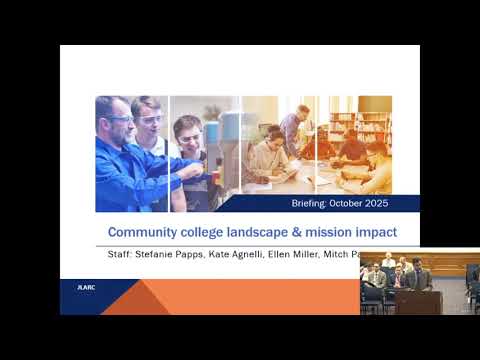
Stephanie Pappst previewed a study of the Virginia Community College System, scheduled for an October briefing, highlighting a decade‑long enrollment decline of about 27% (16% when dual‑enrollment students are counted) and large growth in dual‑enrollment participation. She said the review will examine how the system is adapting, program alignment with labor demand, and potential capital‑funding issues raised in commissioner questions.
Joe McMahon summarized JLARC's review of Virginia's new K–12 accountability framework, which indexes schools on four components — mastery, growth, readiness and graduation — and produces a summative score that assigns labels such as "on track" or "needs intensive support." "The system is broken into four main measures or components," McMahon said, noting JLARC will incorporate official 2024–25 results into a December report.
Britney Utz previewed a June briefing on whether transferring the Department of Juvenile Justice from the Public Safety secretariat to Health and Human Resources would affect youth outcomes, collaboration with HHR agencies, public safety, and state and local costs. "About 3,000 youth are involved in the juvenile justice system at any given time," Utz said, and staff have interviewed Commonwealth's attorneys, detention center representatives and other stakeholders.
Drew Dickinson and Mark Gribben described studies of correctional education (November briefing) and the effects of gun violence on communities (locality‑level research), respectively. Gribben cited a recent 20% rise in homicides over several years and said the gun‑violence study will examine data trends, health and economic impacts, and a range of local programs.
Staff also presented JLARC's biannual impacts report, noting that just over half of JLARC recommendations from the last four years have been implemented in whole or in part and that more than 100 bills and over 100 budget amendments had been introduced in the last two sessions to implement JLARC recommendations.
After the presentations and a period of member questions, the commission voted to adopt the work plan for 2025. The chair called for the voice vote and commissioners responded "aye." The staff said the schedule includes meetings in June, July, October, November and December, with a possible September meeting to be determined.
Next steps: JLARC staff will brief individual studies on the dates announced; the commission's subcommittee on study selection will meet later this year to consider additional directives.