Get Full Government Meeting Transcripts, Videos, & Alerts Forever!
Get email alerts on the Workplan Selection topic
No spam. Unsubscribe anytime.
JLARC subcommittee outlines candidate studies for 2026, asks staff to draft resolutions
Summary
The JLARC study topic selection subcommittee reviewed staff proposals for 2026 and signaled support for several focused reviews — including DMAS MCO oversight, an ABC authority review, assisted‑living/long‑term care, the Virginia Innovation Partnership Authority, and water/Chesapeake Bay programs — and asked staff to draft study resolutions and return with prioritized recommendations.
The Joint Legislative Audit & Review Commission study topic selection subcommittee met and directed staff to draft study resolutions for several candidate topics for 2026, with the expectation the subcommittee will return a ranked list to the full commission.
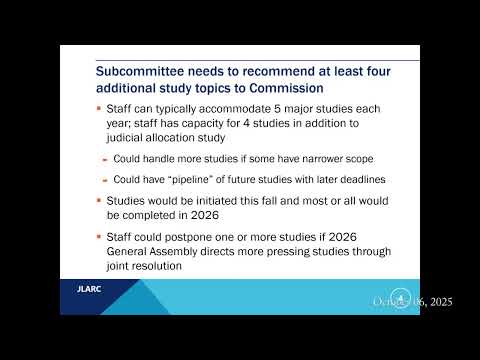
Hal Grama, JLARC staff director, introduced staff and handed the meeting to Justin Brown, JLARC senior associate director. Brown said, “We'd like to start the process of identifying our 2026 study topics,” and explained the subcommittee needs to recommend at least four additional topics beyond two already referred by joint resolution (including a large judicial allocation methodology study).
Members discussed a slate of staff ideas that staff said could be drafted into study language. The topics members engaged on most included a focused look at Department of Medical Assistance Services (DMAS) oversight of managed‑care organizations, an agency review of the Virginia Alcoholic Beverage Control (ABC) authority, a review of assisted‑living and long‑term care options and supply, the Virginia Innovation Partnership Authority, and state roles in drinking‑water and food safety tied to Chesapeake Bay nutrient reduction. Telegra Rasul and other members also proposed a study of artificial intelligence’s effects on workforce, education and information integrity.
Members asked staff to prepare draft study resolutions and additional research on level of effort and scope. The subcommittee agreed staff would return with a prioritized list for the full commission to consider after the session; staff suggested reconvening the subcommittee in a follow‑up meeting (suggested dates included November or the May work‑plan meeting) to rank studies.
Next steps: staff will draft study resolutions and scope language for the candidate topics discussed and present a recommended ranking to the subcommittee and then to the full JLARC commission.