Get Full Government Meeting Transcripts, Videos, & Alerts Forever!
Get email alerts on the Public Safety topic
No spam. Unsubscribe anytime.
Horace council approves license‑plate‑reader cameras but declines fourth deputy for 2025
Summary
After a sheriff’s update, the council approved placement of Flock license‑plate‑reader cameras (county‑operated, data retention 60 days, used only for entered investigative hot lists) and, following budget and staffing concerns, voted not to add a fourth contracted deputy for 2025.
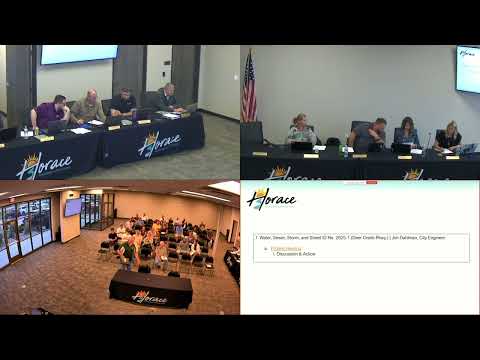
The Horace City Council on July 7 approved a request from the Cass County Sheriff’s Office to deploy Flock license‑plate‑reader cameras in and near Horace, and separately decided not to add a fourth contracted deputy for 2025 amid concerns about county budget constraints.
Sheriff Johnner told the council the camera system operates by matching plates against plates entered into an investigative hot‑list; the system is not automatically flagging every vehicle and data entries automatically expire after 60 days. He said the system is intended to assist investigations and proactive policing, not to issue traffic citations. Council members asked about privacy protections, training, searchable scope and retention; the sheriff said use would be limited to entries related to suspected criminal activity and that the county would not use the system for routine traffic enforcement.
Councilor comments ranged from privacy caution to support for improved investigative capability. One councilor said public questions were mostly about whether cameras would issue speeding tickets; the sheriff answered that they would not be used for that purpose. After discussion, the council voted to approve the Cass County Sheriff's Office’s use of the Flock safety cameras.
Later in the agenda the council considered adding a fourth contracted sheriff’s deputy. The sheriff explained the county’s partnership model: the county supplies equipment (estimated roughly $105,000) and salary/benefits are roughly $100,000 a year, normally split 50/50 with contracting cities. He also warned that a recently passed state tax cap could create a $4.7 million county deficit and a multi‑year hiring freeze, putting the county’s ability to sustain additional hires at risk. Councilors discussed calls‑for‑service, officer ratios and longer‑term budget implications. By majority vote the council decided to forego adding a fourth contracted deputy for the remainder of 2025; staff and sheriff’s office will revisit the request as budgets and staffing evolve.
The council did not adopt additional restrictions or conditions on the camera approval beyond the discussion at the meeting; sheriff’s staff said they would coordinate any implementation details and community outreach.