Get Full Government Meeting Transcripts, Videos, & Alerts Forever!
Get email alerts on the Electronic Participation topic
No spam. Unsubscribe anytime.
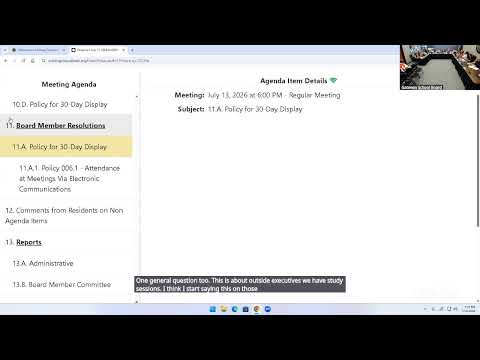
Board tables rewrite of electronic‑attendance policy after members raise legal and operational concerns
Summary
The board debated a rewrite of policy 0061 to restrict virtual attendance to extraordinary circumstances and limit remote participation; members questioned removal of prior exceptions, approval authority and the policy's treatment of executive sessions. The board voted to table and return the policy for further work by the policy committee.
The Gateway School District board discussed a proposed rewrite of policy 0061 to limit virtual attendance at meetings to "extraordinary circumstances" and to require advance notice and approval. The policy would permit remote participation only with a three‑day notice except in sudden illness or emergencies and would cap virtual participation at three meetings per year without special approval.
Chair (Chair, speaker 4) introduced the proposed policy language, which removes several prior enumerated exceptions and names approval by the board president for many requests. Several board members questioned both the removal of explicit exceptions (illness, family emergency, military obligations) and the concentration of approval authority in the president. "So why the change in the policy if we're still going to allow?" one member asked, noting the policy text now relies on presidential approval for "other circumstances."
Solicitor Chelsea (Solicitor, speaker 7) advised the board on legal constraints under the Sunshine Law and made a distinction between executive sessions and regular public meetings. She recommended requiring physical presence for executive sessions because those proceedings often involve sensitive personnel matters, and she described "necessary absence from the district" as leaving jurisdictional boundaries for unavoidable reasons such as mandatory work travel or military deployment. Chelsea said the Sunshine Law requires a quorum of physical bodies for certain actions and cautioned the board to clarify the policy language and approval flow.
Board members argued over whether approval should lie with the president or require validation by both president and vice president or the board, whether vacations should count against a three‑meeting limit, and whether to separate executive and regular meeting rules. After extended discussion the board voted to table the item and send it back to the policy committee for revision and clearer definitions of approval and limits.
The board did not adopt the rewritten policy at the meeting; members directed staff and the policy committee to redraft the policy to distinguish executive-session rules and to clarify who approves remote participation and what counts against the annual limit.