Get Full Government Meeting Transcripts, Videos, & Alerts Forever!
Get email alerts on the Short Term Rentals topic
No spam. Unsubscribe anytime.
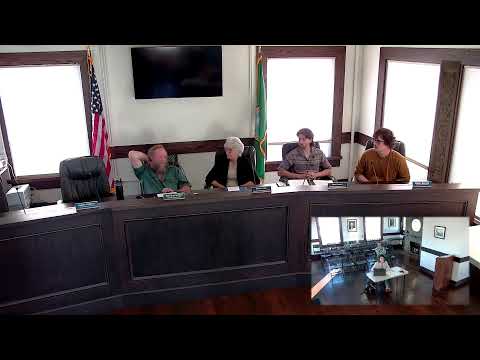
Tenino planning commission asks council to pursue short-term rental and ADU code updates
Summary
The Tenino Planning Commission voted July 8 to ask city council to authorize further research and drafting of code updates to clarify short-term rental rules, update bed-and-breakfast language and align accessory dwelling unit (ADU) rules with state law; staff will contact peer jurisdictions and return with options and cost estimates.
On July 8, 2026 the Tenino Planning Commission voted to send a package to city council asking that the city pursue code updates to clarify short-term rentals, update bed-and-breakfast language and revise associated ADU rules.
City planner Melissa told the commission that Tenino’s municipal code does not explicitly mention short-term rentals and that, in practice, uses not listed as permitted are often treated as not allowed. “Short term rental means a lodging use that is not a hotel or motel or bed and breakfast in which a dwelling unit or portion thereof is offered or provided to a guest by a short term rental operator for a fee for fewer than 30 consecutive nights,” Melissa said, reading the RCW definition into the record and noting the statutory definition excludes bed-and-breakfasts.
That discrepancy, she said, argues for creating a standalone short-term rental section rather than treating short-term rentals as bed-and-breakfasts. Melissa also advised matching local definitions to state law where appropriate and flagged a state requirement that jurisdictions allow up to two ADUs on a lot, subject to life-safety and siting limits.
Commissioners discussed trade-offs between encouraging ADU construction to expand long-term housing supply and the risk that permitting whole-house short-term rentals would encourage investors to convert single-family housing into transient lodging. “If someone can make more money Airbnbing five houses … they’re probably going to do that,” the Chair said, stressing concerns about losing affordable housing stock.
On costs, Melissa estimated drafting a code amendment could require roughly 10–20 staff hours — “about $1,000 to $2,500” depending on complexity — while another commissioner cautioned that attorney review and the full approval process could push total processing costs into the “maybe $5,000 to $10,000” range.
Commissioners emphasized enforcement questions. Melissa said Tenino’s system is largely complaint-based and offered to contact planners in Langley, Olympia and Thurston County to learn how they manage enforcement in practice. She also noted that some jurisdictions opt not to act until demand or complaints justify the expense.
The commission’s motion, offered by Commissioner (S6) and seconded by Commissioner (S2), asked staff to prepare code language and background — revising the bed-and-breakfast code, drafting a standalone short-term rental section that primarily focuses on ADUs if the commission prefers, and updating ADU-related definitions to meet state requirements — and to return with cost and enforcement options for council consideration. The Chair called for the question and commissioners voted in favor; the motion passed.
Melissa said she would present the commission’s discussion and request to city council and continue research, including outreach to peer jurisdictions, enforcement options, and more precise cost estimates. No final code change was adopted at the meeting; the action refers the topic to council for authorization to proceed.