Get Full Government Meeting Transcripts, Videos, & Alerts Forever!
Get email alerts on the Critical Energy Transition Minerals topic
No spam. Unsubscribe anytime.
UN deputy secretary-general urges fast, fair governance of critical energy transition minerals
Summary
At the first UN high-level meeting on critical energy transition minerals, the Deputy Secretary-General urged rapid, rights-respecting policies to ensure producing countries and communities benefit from extraction, outlined three priority fronts, and said the UN will coordinate implementation.
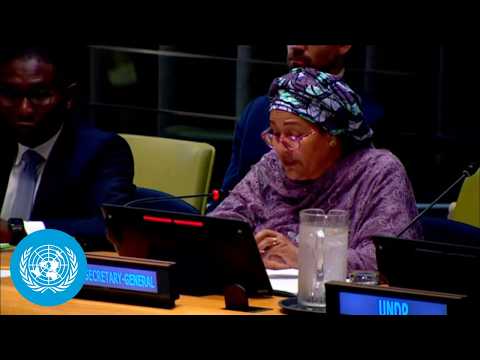
The Deputy Secretary-General urged governments, industry and international institutions to move quickly to ensure critical energy transition minerals benefit producing countries and frontline communities, saying the transition must be "fast, fair, and inclusive." She made the remarks at the first UN high-level meeting on critical energy transition minerals.
"Advancing the energy transition at speed and scale has never been more urgent or vital," the Deputy Secretary-General said, linking the pace of action to the twin crises of climate change and global energy insecurity.
She identified copper, lithium, nickel, cobalt, graphite, silicon and rare earths as "the building blocks for electric vehicles, wind turbines, solar panels, and grid scale batteries" and warned that global demand for these minerals "is expected to more than double by 2040." The remarks stressed that mineral demand now reaches beyond energy into manufacturing, health and defense sectors.
The Deputy Secretary-General framed the moment as an economic opportunity and a justice challenge. She said resource-rich developing countries "remain trapped at the margins, relegated to exporters of raw materials while others reap the profits," and that mining communities frequently face environmental harm and unsafe labor conditions.
Citing regional disparities, she said Africa holds "around 30% of global critical mineral reserves, yet it receives just 2% of global and clean energy investment," and warned that competition for mineral resources can fuel instability and displacement.
To secure a just transition, she outlined three priority fronts. First, governments must ensure extraction delivers "fair, equitable, and sustainable outcomes" by strengthening capacity to negotiate equitable mining agreements, expanding domestic processing and refining, and retaining value at source. "The UN secretary general's panel on critical energy transition minerals has told us exactly how to do that," she said, describing the panel's guiding principles as a "blueprint" for protecting rights and enforcing environmental safeguards.
Second, she urged stronger international collaboration and "equitable partnerships between producers and consumers," warning that bilateral deals that trade access for security or resources for infrastructure can risk exploitation and undermine sovereignty. She called for rules-based frameworks that include technology transfer, infrastructure investment and transparent due diligence.
Third, she demanded "full and unquestioned respect for human rights and environmental integrity at every stage," calling specifically for protections for indigenous peoples, workers, children, women and human-rights defenders, and for governance measures such as transparency, traceability and anti-corruption safeguards across supply chains.
The Deputy Secretary-General said a UN task force is coordinating system-wide action to support delivery on the ground and welcomed commitments from governments, industry, international institutions and civil society. She said she "very much look[s] forward to hearing from you today on your plans to implement the UNSG's panel findings and strengthen international collaboration on this important issue."
Solhin, the meeting moderator, thanked the Deputy Secretary-General and returned the floor.