Get Full Government Meeting Transcripts, Videos, & Alerts Forever!
Get email alerts on the Student Policy topic
No spam. Unsubscribe anytime.
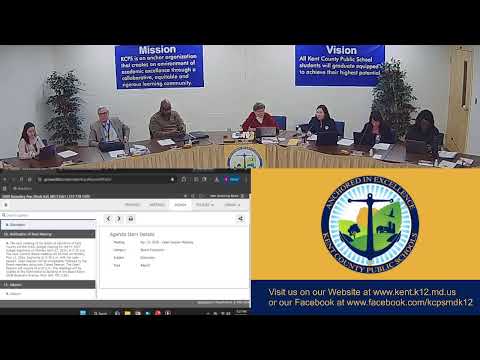
New state law forces Kent County schools to craft phone policy; board weighs exemptions and storage
Summary
Superintendent Dr. McComas briefed the board on a required district cell‑phone policy after the legislature passed bills (referenced as SB 928 and HB 525) that will prohibit student phone use during the academic day with specific exemptions; the board discussed storage options, smartwatches and operational challenges.
The Kent County Public Schools board heard an informational update on April 13 about a required student cell‑phone policy after recently passed state legislation. Superintendent Dr. McComas said the latest bills (referred to in the meeting as Senate Bill 928 and House Bill 525) require each district to adopt a board policy no later than the 2027–28 school year and to prohibit student phone use during the academic day with enumerated exemptions.
Dr. McComas summarized the exemptions the law would permit: devices required by a student's IEP or 504 plan for documented health‑monitoring needs, use when directed by an instructor as part of a lesson, access to translation tools when district devices are insufficient, and principal‑approved use for caregiving responsibilities. "Each school will establish an operational procedure for storing students' cell phones during the academic day," she said, noting that some middle schools already use calculator pouches as a practical storage approach.
Board members raised implementation questions and concerns. Mister Queen said he was wary of overly strict rules for high‑school students and asked whether the policy risks "handicapping" older students who rely on devices for internships and college work. A student speaker described a classroom practice: "We each have a number, and we each put our phone in the number and... my teacher can see if someone had a number missing," illustrating one building‑level approach to accountability.
The board discussed the reach of the law — which staff said covers electronic communication devices (including many smartwatches) — and debated whether the district should implement a tiered approach, with stricter rules for middle grades and more discretion at the high‑school level. Several board members urged combining a policy with parent education and digital‑citizenship curriculum so families understand the rationale and feel confident about safety and supervision.
Dr. McComas said she plans to return with a draft policy and an implementation plan that will include building‑level procedures, parent workshops, and a timeline for implementation, proposing to pilot or implement next school year so the district can learn and refine practices before the statutory deadline.