Get Full Government Meeting Transcripts, Videos, & Alerts Forever!
Get email alerts on the Housing Rezoning topic
No spam. Unsubscribe anytime.
Colts Neck committee adopts settlement to keep Hires Mill parcel residential and advances rezoning tied to Mount Laurel compliance
Summary
The committee approved a settlement to prevent an eight‑unit strip mall on Hires Mill Road and advanced Ordinance 20‑26‑14 (first reading) to rezone 68 Aubrey Road as part of court-ordered affordable‑housing compliance; counsel warned that failing to rezone could strip the township of immunity from builders‑remedy lawsuits.
The Colts Neck Township Committee approved a settlement to resolve litigation over a Hires Mill Road application and advanced an ordinance (first reading) intended to meet a court‑ordered affordable‑housing obligation.
On the Hires Mill Road matter, the committee said the settlement requires the parcel to remain residential and to be rezoned as a flag lot rather than developed as an eight‑unit commercial strip mall. A planning‑board member said the board had previously denied the commercial proposal after resident opposition, and committee members said the settlement better protects the neighborhood’s character.
The committee then conducted a first reading of Ordinance 20‑26‑14, a supplement to Chapter 102 (development regulations) affecting a site at 68 Aubrey Road. Committee members described the rezoning as necessary to satisfy a court order that requires the township to provide 212 units in the round‑4 plan; counsel Matt Collins explained that complying with the court’s directive and rezoning the specified properties preserves the town’s immunity from "builders‑remedy" lawsuits under the Mount Laurel doctrine.
Counsel said that if the township fails to rezone and loses immunity, a developer could immediately file suit to rezone parcels, potentially overriding local zoning. Deputy mayor (speaker 3) warned that voting no would likely result in more unwanted development, stating, "Voting no is a vote for more development, not less." Committeeman Tabia recorded a public vote of no on the ordinance first reading citing a positional conflict; other members voted yes.
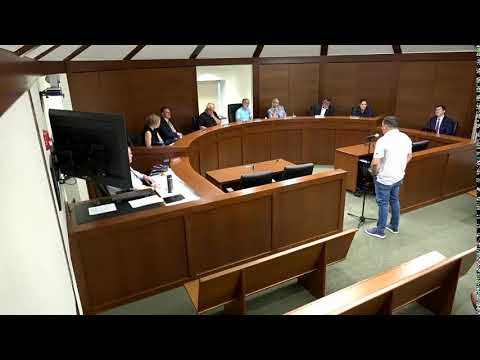
During public comment, residents asked whether land preserved with open‑space trust funds could still be taken by the state via eminent domain. Town counsel responded that land acquired and placed on the Recreation and Open Space Inventory or preserved with open‑space trust funds receives statutory protections and that reversal is costly and legally constrained.
Next steps: the ordinance was introduced on first reading and will return for a second reading on Aug. 12, 2026; the planning board will consider related matters at its next meeting.