Get Full Government Meeting Transcripts, Videos, & Alerts Forever!
Get email alerts on the Water Quality topic
No spam. Unsubscribe anytime.
Washburn official urges residents to complete service-line survey ahead of 2027 lead-rule baseline
Summary
At a Washburn public session, presenter Eric said an online survey (with photo) is live to help identify service-line materials; the town has about 68 private-side unknowns and 407 public-side unknowns, LCRI compliance on 2027-11-01 will make unknowns assumed lead, and door-to-door help starts in January.
Eric, the presenter, told residents at a Washburn information session that the city is working with state-funded contractors to identify water service-line materials and reduce the number of “unknown” entries before the federal/state compliance baseline on Nov. 1, 2027.
The electronic survey is live and requires a photo attachment. "The state and EPA [are] requiring a photo," Eric said, demonstrating how residents can scan a QR code or enter a URL to upload an image and identify whether their private-side service line is plastic, copper, lead or galvanized.
Why it matters: under the Lead and Copper Rule Improvements (LCRI) the inventory on 2027-11-01 becomes the baseline; Eric warned that "any unknown service lines that the city has at that point are assumed to be lead," which would count toward the city’s mandatory replacement schedule. He said Washburn currently has about 68 unknown private-side lines and roughly 407 unknown public-side lines.
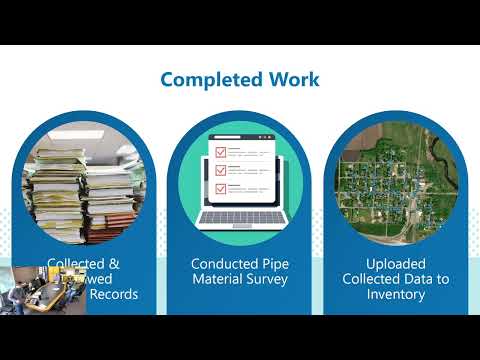
Eric outlined how the program will proceed. Category A work (records review and initial inventory) was submitted to the state portal in fall 2024; Category B will repeat record review, reissue the survey and add door-to-door assistance starting in January, with AQS staff assisting city crews. "If we sent out that survey and we're not getting a response from it, we're gonna come visit people and ask if we can assist them in completing the survey," he said.
Testing and compliance changes are coming: the lead action level moves from 15 micrograms per liter (15 parts per billion) to 10 parts per billion under LCRI, and sampling will expand. Eric said monitoring will be required every six months with more samples and will include both first- and fifth-liter samples; the fifth-liter sample better represents water sitting in the service line.
On replacements and funding, Eric said the LCRI timeline requires systems to replace 10% of known lead service lines per year over 10 years once replacements begin, and that Washburn currently has 15 known lead lines. He recommended State Revolving Fund (SRF) assistance as the principal funding route, noting SRF loans can be repaid over 30 years at about 2% interest and the state has offered up to 66% loan forgiveness for some communities, depending on state 'disadvantaged community' criteria.
Residents asked technical questions about whether sampling volume depends on service-line length or house size; Eric responded that the fifth liter is representative for most homes but very large premises might require different consideration.
Next steps: the survey remains live now; residents who complete it may avoid a field visit. Door-to-door assistance is scheduled to begin in January, and Eric said he would remain after the meeting to help anyone who needs assistance completing the survey.