Get Full Government Meeting Transcripts, Videos, & Alerts Forever!
Get email alerts on the Local Revenue topic
No spam. Unsubscribe anytime.
Berkshire Local board votes to place 0.5 percentage-point earned income tax increase on Nov. 3 ballot
Summary
The Berkshire Local Board voted to place a ballot question on Nov. 3, 2026 asking voters to raise the earned income tax from 1% to 1.5% (a 0.5 percentage-point increase). Board leaders said the move is intended to avoid a projected fiscal 2029 deficit and that seniors' retirement income would not be affected.
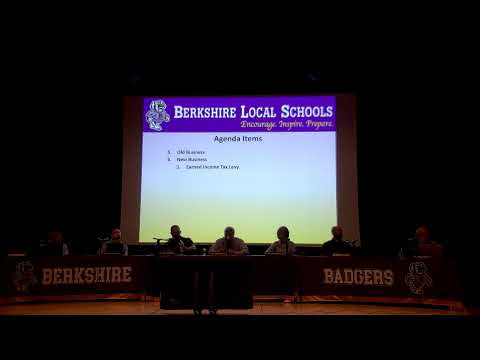
The Berkshire Local Board of Education voted to place a 0.5 percentage-point increase in the district's earned income tax on the Nov. 3, 2026 ballot, raising the rate from 1% to 1.5%. Chair opened the new-business discussion and Clerk Beth and Superintendent John recommended the board proceed with the 0.5 increment as the most appropriate certified option.
Why it matters: Board members said the district faces a projected operating shortfall in fiscal year 2029 and must either raise revenue or cut roughly $1,300,000 from the budget. Clerk Beth told the board the state will not allow a negative fund balance, and said placing the measure on the ballot preserves local control of the response to the shortfall.
What the board discussed: Beth outlined certified increment options that had been modeled—0.25, 0.50, 0.625 and 0.75 percentage points—and recommended the 0.50 option as the "sweet spot." John noted the district is currently at a 1% earned income tax and described how the proposal would change that to 1.5%: "We're at 1% right now, so it would be 1 and a half percent," he said. Beth warned of the potential cuts without new revenue: "There's like 1,300,000 that needs to be cut in order to make up for that deficit in '29," she said.
The board also discussed who the levy affects. Beth and John emphasized that the earned income tax applies to earned wages and not to retirement or investment income; John said seniors drawing only retirement income would not pay the levy because it is levied on earned income. Board members asked for clarification about calculation methodology and the fiscal forecast; Beth said the district had run models and that 0.25 would not eliminate the projected shortfall.
Vote and next steps: Chair moved the resolution to proceed with a ballot question reflecting a 1.5% total rate (an additional 0.5 percentage point); the motion was seconded and approved by roll call. The board instructed staff to place the resolution on the Nov. 3, 2026 ballot as a permanent rate (not a temporary renewal). The board expects to present a fiscal forecast in August and continue public outreach before the election.
What remains unresolved: The ballot question puts the decision to voters; the transcript records the board's recommendation and vote to proceed but does not include specifics on the expected revenue yield of the 0.5 increase, detailed exemptions, or a formal public outreach timeline. Those details are to be provided in the district forecast and materials to voters.