Get Full Government Meeting Transcripts, Videos, & Alerts Forever!
Get email alerts on the Lehd Tools Webinar topic
No spam. Unsubscribe anytime.
Census webinar demos LEHD mapping and analysis tools for workforce, disaster and veteran outcomes
Summary
In a Census Bureau webinar, supervisory program analyst Arlene Dowell demonstrated LEHD products — OnTheMap, OnTheMap for Emergency Management, QWI Explorer, Job-to-Job flows, VEO and PSEO — showing how users can map commuting patterns, estimate disaster-area vulnerabilities and examine veteran and postsecondary earnings outcomes.
Arlene Dowell, supervisory program analyst with the U.S. Census Bureau’s Longitudinal Employer-Household Dynamics (LEHD) program, used a webinar demonstration to show how LEHD data tools help map where people live and work, analyze job flows and estimate population vulnerabilities during disasters.
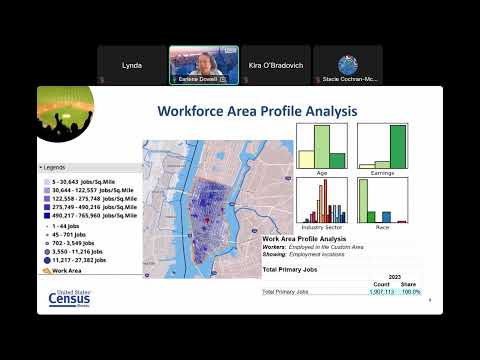
Dowell described OnTheMap as “a web based mapping and reporting application that shows where workers work and where they live,” and used a Manhattan example to illustrate. A screenshot she displayed showed 1,907,113 primary workers for a custom area below 60th Street and industry and age distributions in that workforce. In a live demo she ran OnTheMap’s inflow/outflow mode and reported 1,709,876 people traveling into the selected area, 197,327 living and working there, and 106,039 living in the area but traveling out to work.
The presenter emphasized export and customization options, saying users can generate reports in PDF, Excel or HTML and export shapefiles. She also noted that OnTheMap’s data run historically from 2002 through 2023 for most states and that users can analyze at fine geographies, down to census blocks, with disclosure-protection applied.
Dowell introduced OnTheMap for Emergency Management as a sister tool that pairs ACS and 2020 decennial data to help estimate populations and vulnerabilities during events such as hurricanes, floods and wildfires. Using a Palisades fire example focused on Topanga, California, she highlighted ACS-derived counts — a population shown as 8,878 and an estimated 452 people age 65 and over with a disability who may need assistance evacuating — and pointed out vehicle-availability and housing-age metrics that can inform response planning.
Other LEHD products Dowell demonstrated included the Quarterly Workforce Indicators (QWI) Explorer, which provides 32 indicators and detailed NAICS-level data; a Pennsylvania construction case study where residential remodelers outnumbered some new-construction NAICS and showed different earnings; and the Job-to-Job (J2J) Explorer, which tracks job reallocation (Dowell cited 8,498 workers leaving California for Texas in the period shown and noted top destination industries such as healthcare and social assistance).
Dowell also previewed experimental products: Veterans Employment Outcomes (VEO), expanded to cover multiple service branches and showing earnings percentiles after discharge, and Postsecondary Employment Outcomes (PSEO), which links graduate records to employment outcomes at 1, 5 and 10 years. She cautioned that some numeric transcription in the live demo was garbled in the session transcript and directed users to the posted materials for precise figures.
In Q&A, Dowell confirmed that QWI incorporates QCEW employer-reported data. When asked how LEHD accounts for remote workers, she said, “So currently, we don't have remote workers,” adding that analysts can infer remote-capable occupations (for example, finance and insurance or professional services) but that LEHD does not yet record remote-work status and the team is exploring options to address that gap.
Dowell and the hosts told attendees the recording, slides and transcript will be posted on the Census Academy pages at census.gov and pointed users to LEHD documentation and training materials for step-by-step guides. The webinar closed after a brief additional question-and-answer period.