Get Full Government Meeting Transcripts, Videos, & Alerts Forever!
Get email alerts on the Public Safety Campus topic
No spam. Unsubscribe anytime.
Rutherford County committee splits on condemnation; forwards public safety campus question to full commission
Summary
After a consultant outlined costs and operational benefits for a new horizontal public safety campus adjoining the county workhouse, the Budget, Finance and Investment Committee deadlocked on a condemnation authorization and instead forwarded the acquisition and related funding items to the full commission with a neutral recommendation.
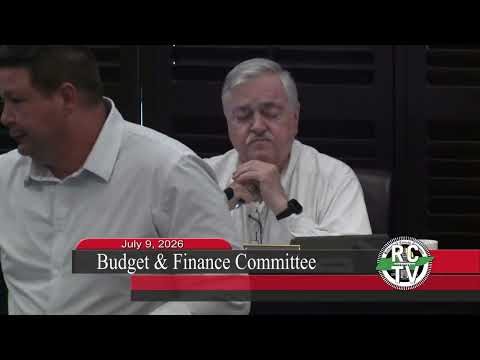
The Rutherford County Budget, Finance and Investment Committee on July 9 heard a detailed presentation on options for a new public safety campus and narrowly decided to send the question of land acquisition to the full county commission without a recommendation. The committee was unable to produce a favorable recommendation on a resolution that would authorize negotiation and, if necessary, eminent-domain proceedings for a 52.67-acre site adjacent to the county workhouse.
Bart Klein, a consultant with Klein Sweeney Associates, told the committee the current nine‑story jail and sheriff's campus is operating well beyond intended capacity, has life‑safety and ADA deficits, and faces extensive deferred maintenance costs. Klein said the existing campus would require substantial infill to meet flood‑elevation code and that retrofits and deferred maintenance work could total in the tens of millions; he estimated a full renovation/expansion in the range of roughly $289 million for a 1,200‑bed option to $342 million for a 1,500‑bed option. Building a new horizontal campus on the 52.67‑acre site was estimated at about $330 million to $375 million, with contingency and inflation factored in.
Klein told the committee the alternative site can support horizontal construction and shared services (kitchen, laundry, medical) that could lower long‑term operating costs. He said the site appears to contain about nine acres of likely low‑quality wetland and asserted there is no flood plain on the parcel; he recommended environmental testing and wetlands delineation as the next step.
Committee members asked for financial detail, including present‑value comparisons of long‑term operating savings versus upfront acquisition and construction costs. Finance staff warned that adding a large capital project to the county's existing capital plan would require additional money in the county's debt service fund and could force changes to the tax rate or reallocation of other debt capacity.
County attorney Nick Christensen summarized the resolution before the vote: voluntary negotiation would be pursued first, and if unsuccessful the county would be authorized to pursue condemnation; the resolution also included a range for preliminary expenditure in the acquisition process ($14 million to $18 million). On the committee's first vote, the motion to recommend the condemnation resolution failed on a tie. A subsequent motion to forward the resolution to the full commission with a neutral recommendation passed 4‑2.
The committee also voted to send two linked items (initial bond resolution and a budget amendment tied to funding options) to the full commission with a neutral recommendation. Separately the committee approved an amendment to KSA's contract that included a not‑to‑exceed $5,000 allowance for condemnation support services and set the design fee for later phases (the amendment specifies design fees would not be billed until the board authorizes the next phase).
The committee recorded no final acquisition or expenditure decision; its action moves the question to the full county commission, which will consider the condemnation authorization, funding resolutions and the KSA contract amendment. Staff said environmental reports and a final program report will be delivered to the committee soon and that the design phase would run about 12–16 months if authorized, followed by 24–36 months of construction.
What happens next: the full county commission will receive the condemnation resolution and related funding items for its consideration. The committee requested more detailed financial analyses (including present‑value comparisons of operating savings) and environmental testing before final decisions on site selection and funding.