Get Full Government Meeting Transcripts, Videos, & Alerts Forever!
Get email alerts on the Artificial Intelligence topic
No spam. Unsubscribe anytime.
Federal Reserve presenter says AI could widen or reduce inequality; policy choices will matter
Summary
A presenter at a Federal Reserve Board conference outlined scenarios in which generative AI could either widen U.S. income and wealth inequality or help reduce it, urging action on education, workforce training and competition to influence which outcome occurs.
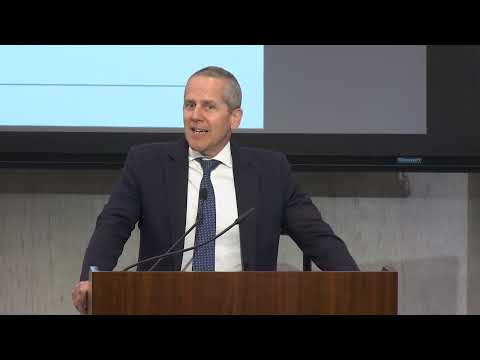
Presenter, an agency official at the Federal Reserve Board, told a conference audience that generative artificial intelligence could have either broadly beneficial or deeply unequal effects on the U.S. economy and financial inclusion.
"AI has the potential to transform lives and the U.S. economy," the presenter said, adding that the technology could "empower workers to be more productive" but also "exacerbate inequality, eliminating some lower and middle income jobs while boosting the income and wealth of higher income individuals." The speaker framed analysis through scenarios rather than predictions.
Why it matters: The presenter said how AI is adopted and who gains access to its capabilities will shape whether gains are broadly shared or concentrated among a few firms and investors, with consequences for financial inclusion.
Key points: The presenter broke income into labor earnings and returns to capital and cited distribution figures for 2024, saying the "highest earning 0.2 percent of U.S. households earned 52 percent of all income, and the bottom 20 percent earned only 3 percent." On wealth, the speaker stated that the bottom 50 percent of U.S. households hold less than 3 percent of wealth, while the top 0.1 percent hold 59 percent.
Mechanisms for greater inequality: The presenter identified two central risks. First, labor displacement: younger and some college-educated workers could face reduced demand for their labor if AI substitutes for tasks now performed by people. Second, concentration: because AI development benefits from access to data, model improvements, and computing power, "hyperscalers" could emerge whose advantages magnify returns to owners and concentrate economic gains.
Evidence and nuance: The presenter cited the Federal Reserve's survey of household economics and decisionmaking, noting that 43 percent of workers with a graduate degree reported using AI in the previous month versus 10 percent of workers with a high school degree or less, and that workers who used AI were more likely to say it would improve their careers rather than replace jobs.
Scenarios for reducing inequality: The presenter described countervailing pathways in which AI is democratized as a capability: providing tutoring, coaching, coding assistance and entrepreneurship tools that could lower barriers and raise productivity, especially for lower-skilled workers. He cited an experiment in which college-educated professionals completed a second round of assignments with AI help, reducing average completion time by 40 percent and improving result quality by 18 percent.
Policy levers: The presenter emphasized that policy choices outside the Federal Reserve's direct remit—education, job training and workforce development, competition policy, and tax policy—will matter in determining outcomes. He recommended broad access to high-quality, affordable training and stressed the importance of human judgment, curiosity and interdisciplinary skills alongside technical ability.
Conclusion: The presenter concluded that it is unclear whether AI will reduce or increase income and wealth inequality, but said "society can begin making choices now that can affect that outcome," urging policymakers to consider interventions that broaden access to AI capabilities and preserve competition.
The remarks closed without mention of formal votes or motions.