Get Full Government Meeting Transcripts, Videos, & Alerts Forever!
Get email alerts on the Seattle Transit Measure topic
No spam. Unsubscribe anytime.
Public commenters at Seattle hearing urge council to send transit measure to voters and reject weakening amendments
Summary
At a July 13 remote public hearing, dozens of riders, disability advocates, labor and climate groups urged the Select Committee on the Seattle Transportation Benefit District to send Council Bill 121226 to the November ballot and to reject amendments (notably 3, 4, 5 and 13) that would reduce transit funding or delay renewal.
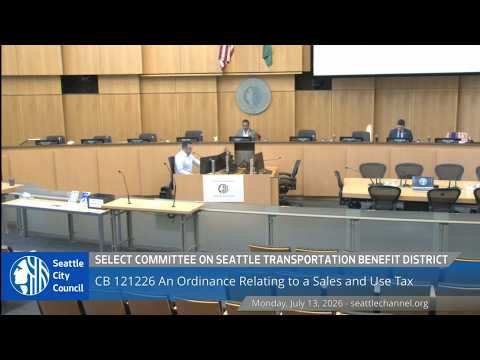
The Select Committee on the Seattle Transportation Benefit District held a remote public hearing July 13 on Council Bill 121226, a proposed sales-and-use tax measure to fund transit and related transportation programs that would go before Seattle voters on Nov. 3, 2026. Chair Rob Sacca opened the morning session and said public comment is “the backbone of responsiveness” as the committee considers proposed amendments and the mayor’s package.
Dozens of remote callers—riders, advocacy groups, labor representatives and students—urged the committee to send the measure to the ballot largely intact and to reject amendments they said would weaken service. ‘‘If we want our city to be affordable, accessible, and to meet its climate goals, we must not halt this progress by cutting transit,’’ said Owen Begley Collier of Ballard, a regular transit rider. Several commenters named amendments 3, 4, 5 and 13 specifically as proposals they wanted the council to reject.
Advocates framed the issue around equity, accessibility and climate goals. Alice Lockhart of 350 Seattle said the measure is “key to reducing transportation climate emissions” and opposed shifting funds or moving the measure to a special election, which amendment 4 would do. Billy Heathering Chen urged preserving capital funding for ADA and sidewalk work, warning that reducing capital investments could undermine the city’s obligations under a 2017 consent decree that requires curb-ramp replacement and extensive sidewalk maintenance.
Labor and construction representatives supported capital elements. Monty Anderson of Seattle Building Trades, speaking for about 20,000 construction workers, said capital investments create family-wage careers and urged support for amendment 3 to prioritize infrastructure repairs and sidewalk expansion.
Several callers highlighted program design and progressive revenue. Ayen Mohammed of the Transportation Equity Work Group, representing Refugee Women’s Alliance, backed a 0.3% tax proposal and praised amendments 11 and 17 for exploring progressive funding; Will Oberst urged expanding income eligibility for transit-assistance programs. Alberto Alvarez and a few others recommended alternative or supplemental approaches—such as taxing car usage or parking—rather than broad sales taxes.
Multiple callers described personal reliance on transit. June Freeman said she works near-minimum wage and does not own a car: ‘‘The only reason I can afford to live in the city is because of the transit access.’’ A high-school speaker, Peter Briggs, said infrequent last-mile service sometimes feels unsafe and urged rejection of cuts that would reduce service.
The clerk recorded 15 remote speakers signed up at the start of the session; the committee recessed midmorning and reconvened at 10:30 a.m. to hear additional callers. Council member Strauss announced he would pull amendment 8 about contracted shuttles after being reassured Hopelink shuttles in use today could continue.
No formal committee vote took place at the hearing. Chair Sacca reminded the public that the committee will meet July 16 to vote on amendments and the legislation itself; the full City Council could consider approval on July 21 to meet ballot deadlines. An in-person public hearing and remaining remote comments were scheduled for 5 p.m. that day.
The hearing was dominated by appeals to keep funding intact to maintain frequent service, expand equity programs and preserve capital spending for accessibility and sidewalks. Committee members will consider those public recommendations as they debate specific amendments in the July 16 session.