Get Full Government Meeting Transcripts, Videos, & Alerts Forever!
Get email alerts on the Energy Storage topic
No spam. Unsubscribe anytime.
NYSERDA official Jen Meniere briefs Troy committee on battery storage benefits, safety and siting
Summary
Jen Meniere, director of clean energy siting at NYSERDA, told the Troy Science and Technology Committee on July 13 that battery energy storage can defer costly grid upgrades and improve reliability, and that updated state fire-code requirements — including mandatory peer review and emergency-response planning for larger systems — have reduced incident rates and apply to local permitting.
Jen Meniere, director of clean energy siting at the New York State Energy Research and Development Authority, told the Troy Science and Technology Committee on July 13 that battery energy storage systems can improve grid reliability, delay expensive infrastructure upgrades and support more renewable generation while state fire-code updates and NYSERDA safeguards have cut incident rates.
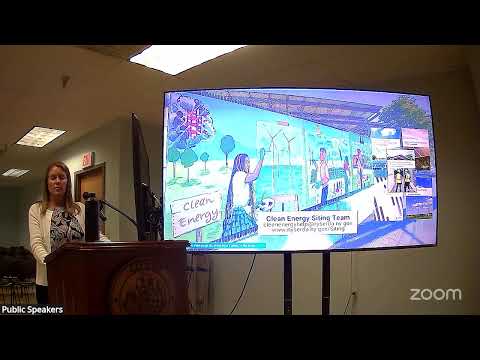
Meniere began the presentation by describing NYSERDA’s clean energy siting team as a free technical resource for local governments, offering guidebooks, model zoning language, permit templates and trainings. “We’re basically free consultants, if you will, for local governments,” she said, and pointed officials to NYSERDA’s online guidebook and a monitored help address, cleanenergyhelp@NYSERDA.ny.gov.
The presentation outlined how batteries can deliver value at different scales: large grid-connected systems can defer costly transmission or distribution upgrades and help balance supply and demand; commercial and industrial users can reduce peak-demand charges by discharging onsite batteries; and aggregated residential batteries can be enrolled in utility programs often described as virtual power plants.
Meniere showed New York Independent System Operator interconnection-queue data and a forecast through 2040 to emphasize anticipated load growth and geographic clustering of proposed projects. She cautioned that projects in the interconnection queue are not guaranteed to be built but said the state has seen growing interest and installations: “We have over 8,000 of them” in New York, she said, adding most are smaller systems.
On safety, Meniere reviewed three large-scale storage fires in New York in 2023 and described the governor’s interagency fire safety working group that led to changes in the New York State Fire Code. She said air, soil and water testing after those incidents “didn’t find any harmful levels of contaminants” and that no one was hospitalized.
Meniere said several protections that had been discretionary are now mandatory for larger systems (about 600 kilowatt-hours and above): peer review paid by developers, site-specific pre-incident or emergency-response plans developed with local fire departments, an annual on-site training offer for first responders, and hazard-support personnel who must be reachable by phone within 15 minutes and able to be on-site within four hours. “Peer reviews is one of those things… now it’s mandatory,” she said.
She described NYSERDA’s own peer-review process for projects the authority incentivizes and said local officials can rely on a NYSERDA peer review to satisfy code requirements if timing allows. The agency also offers recorded trainings for code officials and a live two-hour training that provides Department of State credits.
Committee members asked several practical questions. When asked how often code-official trainings occur, Meniere said they are scheduled about every two weeks with afternoon and evening sessions and that additional sessions can be arranged. Asked whether NYSERDA helps developers choose specific sites in constrained cities like Troy, she said the agency does not perform siting for developers but can help anticipate likely locations (substations are common) and that staff can provide mapping and feedback on draft local code language.
On the causes of the 2023 incidents, Meniere said NYSERDA does not routinely have root-cause analyses because those reports are often proprietary to developers; she observed heavy rains and potential water infiltration have been mentioned in some cases but declined to speculate. She also confirmed the presenter’s dataset showed roughly 33 New York incidents in 2023 and about 24 incidents globally in 2025 on the chart she displayed.
A committee member referenced a proposed blanket 500-foot setback for storage facilities; Meniere said such a blanket setback would likely be prohibitive for many needed systems and urged tailoring setbacks to local context — closer to substations, larger near residential zones. On siting in floodplains, she said developers generally weigh risks case by case and elevated designs may be possible but floodplains are “probably not the best spot.”
The presentation closed with an offer of further technical assistance and an invitation for local officials to request additional trainings or feedback on draft local laws. The committee moved to adjourn after the Q&A; a motion and second were recorded and no vote was included in the transcript.
Provenance: Presentation and Q&A across the transcript beginning with Jen Meniere’s remarks at SEG 031 through the meeting close at SEG 1100.