Get Full Government Meeting Transcripts, Videos, & Alerts Forever!
Get email alerts on the Hazard Mitigation topic
No spam. Unsubscribe anytime.
Clermont County adopts 2025 hazard mitigation plan to retain federal grant eligibility
Summary
The Clermont County Board of Commissioners on July 15 adopted a federally approved 2025 Hazard Mitigation Plan intended to identify the county's top hazards and preserve eligibility for mitigation grant funding. The plan highlights cyber risks, tornadoes, flooding and dam safety.
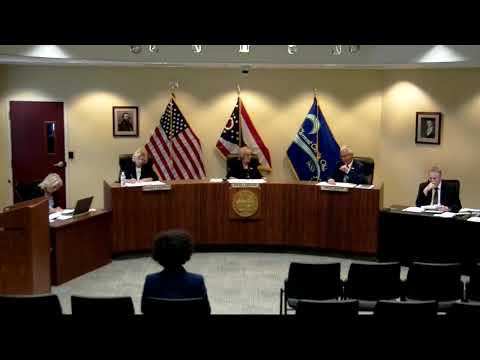
The Clermont County Board of Commissioners voted July 15 to adopt the countywide 2025 Hazard Mitigation Plan, a multi-hundred-page document county emergency staff said is required by federal statute and necessary to maintain eligibility for future hazard-mitigation grant funding.
Sean Riley, director of the Clermont County Emergency Management Agency, told the board the plan — about 480 pages in total, he said — catalogues hazards, assesses risk and proposes mitigation strategies. "We are required, by federal statute to update and compile a hazard mitigation plan at the county level every 5 years," Riley said during his presentation.
Why it matters: Adopting the plan preserves the countys standing to apply for federal Hazard Mitigation Grant Program funds. Riley said the plan sets a multi-year schedule for updates and requires municipalities and townships to adopt the document within a year of the federal date (which staff referenced as June 24) to ensure local jurisdictions are eligible for mitigation funding.
What officials said and proposed: Riley summarized the top 16 hazards identified in the plan. He said cyber incidents have risen in significance because many pieces of public critical infrastructure are now controlled by networked systems. He also listed traditional hazards that repeatedly affect the county: tornadoes, flash flooding and river flooding, severe summer weather, utility failures, hazardous materials transported on the Ohio River, invasive species such as emerald ash borer, and public-health and opioid-related risks. On critical infrastructure and warning systems, Riley said, "I believe it's 57 of [the sirens]," when describing outdoor siren coverage (that figure was presented as an approximate count).
Riley also addressed dam safety: "I believe we actually have 7 class 1 dams in the county," he said, explaining that class 1 designation indicates potential for loss of life or structure in a complete failure; he said emergency action plans exist for those dams and must be updated.
Board action: The board read Resolution No. 11126 to adopt the 2025 Hazard Mitigation Plan (Exhibit A) and to comply with relevant federal guidance (44 C.F.R. Part 201). A motion to adopt the resolution was made, seconded and approved by roll call. Commissioners Corcoran, Painter and Bachelor recorded affirmative votes; the resolution was adopted.
What happens next: After county adoption, Riley said municipalities and townships will have a year from the federal date cited to adopt the plan locally. Once the jurisdictions have adopted the plan, the county and its localities will be eligible to apply for mitigation grants until the next five-year update.
A note on figures and transcription: Several numeric items were presented verbally (for example, the plan page count, siren count and number of class 1 dams) and were prefaced by qualifiers such as "I believe" or "hold me to that." Those figures are reported here as the presenter stated them in the meeting.