Get Full Government Meeting Transcripts, Videos, & Alerts Forever!
Get email alerts on the Septic Systems topic
No spam. Unsubscribe anytime.
Falmouth Board of Health approves denitrifying septic (IA) systems for several properties
Summary
The board approved IA (denitrifying) septic systems or variances for multiple properties — including 348 & 350 Old Meeting House Road, 162 Sandwich Road, Lot 370 Schumacher Road, and 65 Walker Street — finding each proposed system improves nitrogen removal and granting approvals with standard conditions and a 10 mg/L total nitrogen limit.
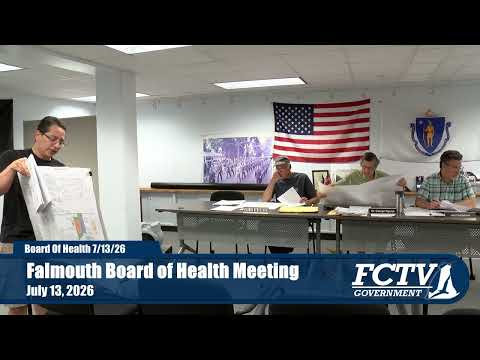
The Town of Falmouth Board of Health approved requests on July 13 for several denitrifying (innovative/advanced, IA) septic systems, finding the proposed systems would improve nitrogen removal compared with existing conditions.
The board approved the IA technology for the combined lots at 348 and 350 Old Meeting House Road after the applicant’s engineer described a denitrifying system proposed for the newly combined parcel. The engineer said the project meets setback requirements and the planning board had approved the lot combination; a board member moved to approve the IA system and the board voted in favor.
At 162 Sandwich Road, the board considered the replacement of an existing cesspool with a Title 5 system and a denitrifying IA system to serve a new two-family dwelling. The applicant’s engineer said the design yields a three-bedroom capacity and that measured loading would decline with the proposed IA. Board members pressed on how historic bedroom counts and permit records affect long-term flow assumptions; after discussion the board approved the IA installation, finding it improves conditions on the lot and attaching the standard conditions and a 10 mg/L total-nitrogen limit.
For Lot 370 Schumacher Road the applicant proposed a five-bedroom system in a nitrogen-sensitive area and Zone 2. Engineers and board members debated whether the proposed gallery/chamber configuration should be treated as a ‘‘trench’’ or a ‘‘bed’’ under Title 5 rules and discussed the stone-contact area engineers use to calculate leaching capacity. The board agreed to approval with the standard condition set and recommended, where helpful, use of a larger distribution box to ease future sampling.
The board also approved a setback-variance request and IA installation for 65 Walker Street, allowing a rebuild to increase from two to three bedrooms; the engineer said the Clean 2 nitro system would reduce modeled concentrations from roughly 10.6 parts per million to about 5 parts per million in the design calculations. Members discussed whether to condition approvals on fertilizer restrictions or distribution-box sizing; the board approved the variance and IA with standard monitoring and a 10 mg/L limit.
Board action on these items was framed narrowly: members described the approvals as case-by-case findings that the proposed technology improves nitrogen removal on the lot and meets Title 5 and local setback requirements. The board did not expand or change regulations during the meeting; members asked staff to consider possible future regulation updates (for sampling access, distribution-box sizing, or standard conditions) to reduce repeated site-by-site questioning.
What happens next: the approvals are conditioned on the standard O&M and monitoring requirements the board enforces; applicants must meet those conditions and permit requirements before systems are finalized.