Get Full Government Meeting Transcripts, Videos, & Alerts Forever!
Get email alerts on the Labor Harmony topic
No spam. Unsubscribe anytime.
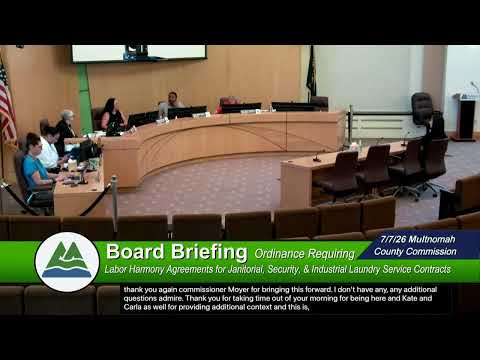
Multnomah County Council hears briefing on ordinance to require labor harmony agreements for janitorial, security and laundry contracts
Summary
Commissioners heard experts and attorneys back a proposal to require labor harmony (labor peace) agreements for janitorial, security and industrial laundry contracts to reduce service interruptions; staff aim to circulate draft ordinance language before a planned first reading on the 16th.
Multnomah County Council members on a board briefing considered a proposed ordinance that would require contractors in janitorial, security and industrial laundry services to demonstrate labor harmony agreements designed to prevent strikes, lockouts or other work stoppages that could interrupt county services.
Commissioner Moyer, who introduced the concept, said the proposal builds on the county’s 2021 labor harmony requirements for behavioral health and preschool services and would take a different approach by requiring evidence of labor peace before a contract is awarded rather than waiting to request it during contract performance. "This version takes into account recent developments by requiring a labor harmony agreement before a contract is awarded rather than upon request by the county," Moyer said.
Panelists who testified said the requirement is intended to protect service continuity and fiscal interests. Carla Walter, a senior fellow at the Center for American Progress, said academic research links labor unrest to reduced productivity and public harms and described labor harmony or labor peace agreements as commitments by signatories to refrain from strikes and employer lockouts. "Labor harmony policies specify that as a condition of government support, companies at risk of labor unrest and their workers must enter into a labor harmony agreement," Walter said.
Local labor attorneys who spoke to the council described on-the-ground worker issues that proponents say the ordinance would help address. Mara Ledesma, an attorney who said she represents low‑wage workers in Portland, described frequent misclassification in janitorial contracting that she said can lead to wage theft and churn in the workforce; she told commissioners she currently represents 33 janitors in litigation alleging such misclassification. "People were stretched very thin across too many buildings...and you really can't get quality janitorial services out of an arrangement like that," Ledesma said.
Kate Sussman of the Northwest Workers Justice Project described a pattern of strikes and near‑strikes in Oregon industries including early childhood education, long‑term care, hospitals and laundry and security work, and noted that similar labor‑peace requirements have been litigated with mixed outcomes. Sussman said federal and local courts have at times upheld comparable labor peace rules when they are drafted narrowly and grounded in a government entity’s market‑participant role.
Commissioners asked whether the ordinance would mirror other local rules and how enforcement and exceptions would work. Moyer said the draft he is preparing is similar in form to Portland’s ordinance but will be written as a county ordinance (rather than a resolution) with clearer language around exceptions and enforcement to improve durability and operability. Panelists urged clear legal justifications and meaningful enforcement mechanisms; Walter recommended penalties and a willingness by the county to enforce them.
Moyer said staff and the county attorney’s office were finalizing draft language and aimed to circulate it promptly; he said the item is scheduled for a first reading on the 16th but cautioned the timeline could slip if the language is not ready. A county attorney confirmed staff were working to finalize the draft.
The briefing concluded with several commissioners expressing support and an invitation to colleagues to cosponsor the ordinance in open meeting; no formal vote or ordinance adoption occurred during the session. The council adjourned and noted its next meeting date.