Get Full Government Meeting Transcripts, Videos, & Alerts Forever!
Get email alerts on the Governance topic
No spam. Unsubscribe anytime.
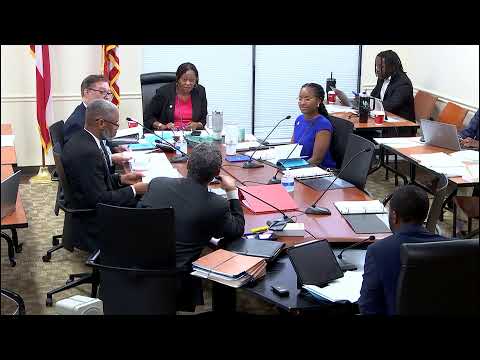
Operations committee advances broad Blue Book revisions on public comment, remote participation and legislative review
Summary
DeKalb County’s Operations Committee advanced a package of standing-procedure changes that clarify when newly elected presiding officers assume duties, authorize three annual evening committee-of-the-whole meetings, impose a 3‑minute/30‑minute public-comment limit with resident priority, require IT-facilitated remote participation, and create a multi-step legislative sponsor/review process that drew debate over a proposed three-sponsor threshold.
The DeKalb County Operations Committee voted to advance a set of proposed revisions to its standing procedural rules (the Blue Book), sending a bundle of consensus items and redlined alternatives for consideration by the full Board of Commissioners.
Central staff read consensus language that would (1) specify newly elected presiding officers and deputy presiding officers assume their roles at the end of the meeting in which they are elected, (2) allow three evening "committee of the whole" meetings each year (February, June and/or October) held at different locations around the county with a public-comment period starting at 6:30 p.m., and (3) add an explicit mechanism for teleconference or remote attendance so long as such attendance complies with the Open Meetings Act.
On public comment, the proposed rules say speakers must complete a card before the public-comment portion of the meeting, DeKalb County residents will be allowed to speak before non-residents, speakers will be limited to three minutes each, and total public-comment time will not exceed 30 minutes. Commissioner Adena Bowden raised logistical questions about how that 30-minute allotment is tracked; the chair said central staff and the clerk should monitor both individual three-minute clocks and the overall 30 minutes.
The committee also debated whether the public-comment rules should bar campaigning from the podium. The chair asked staff to draft clearer language; Attorney Phillips urged caution, noting constitutional limits. As Phillips told the panel: "The Open Meetings Act requires the declaration of an emergency in order to hold a remote meeting," and more broadly he advised careful legal drafting on restrictions that could implicate First Amendment concerns.
On remote participation, the committee accepted language that would require any authorized remote participation to be facilitated by the county’s Innovation and Technology (IT) department; the committee agreed to require that telephone or web participation be "authorized by the presiding officer, deputy presiding officer, or committee chair" and facilitated by IT rather than arranged ad hoc by callers.
One of the more contested proposals was a new legislative sponsor and review process intended to improve front-end vetting: an initiating commissioner would be expected to secure two additional co-sponsors, obtain concurrent administrative and legal review (staff suggested a 30-day feedback window), and then submit the item through the county’s Legistar system. Some commissioners objected that requiring three sponsors would create barriers to introducing items; others said the extra sponsors create efficiency and improve early vetting. Commissioner Terry urged care on First Amendment limits and said restrictions on public comment should be well-researched.
The committee also approved language to prevent items from languishing in committee. Under the adopted alternative, an agenda item assigned to committee that receives no recommendation within a defined committee cycle (four consecutive regularly scheduled meetings or roughly a 90‑day window) will be placed automatically on the full Board agenda as an "expired committee cycle" item, ensuring the matter cannot remain in committee indefinitely.
What’s next: The committee voted to replace the existing subsection on committee recommendations with the revised version crafted in the meeting and to forward the consolidated Blue Book package to the Board of Commissioners for final action. Staff and the county attorney will finalize public-comment language and iron out bracketed text before placement on the Board docket.