Get Full Government Meeting Transcripts, Videos, & Alerts Forever!
Get email alerts on the Planning Procedures topic
No spam. Unsubscribe anytime.
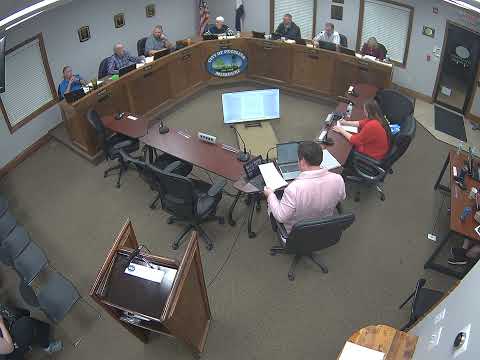
Commission reviews proposed development-review procedures, debates site-plan routing and notice radius
Summary
Staff presented Article 11, consolidating development-review procedures (site plans, plats, findings of fact, PUDs). Commissioners leaned to align notice radius with the state statute (185 feet), debated whether site plans should remain administrative, and asked for clearer MOU/plating safeguards.
Peculiar City staff introduced Article 11 of the code rewrite to consolidate development-review procedures, clarify who decides appeals and public-hearing triggers, and to provide standard findings-of-fact for plats and rezoning. Dylan (staff member) told the commission, “findings of fact are really the biggest thing that you should focus on on any staff report.”
Key elements of the draft include (1) clearer routing and appeal paths (decision, recommendation, appellate authority), (2) standardized findings-of-fact that the commission will use to judge final plats, and (3) a new Memorandum of Understanding (MOU) requirement tied to preliminary plats. Staff explained that if a final plat is substantially different from the approved preliminary plat, the findings-of-fact provide the legal basis to deny the final plat.
Commissioners debated whether site plans should remain primarily an administrative review or be routed to the planning commission/board for public review. Dylan noted that site plans are generally administrative unless located within a planned-commercial (CP) district and warned that, legally, a commission cannot deny an application that meets code: “If it meets code, you cannot deny it.” Commissioners said they want transparency but worry about added delay and the legal exposure that comes from denying code-compliant applications.
The commission discussed public-notice distance. Staff said the city currently notifies within 300 feet but that nearby jurisdictions follow a state statute at 185 feet; several commissioners expressed support for aligning the city with the state statute and a consensus emerged to use 185 feet for notice.
Planned Unit Developments (PUDs), which allow mixed-use developments and flexible standards, were discussed at length. Commissioners recalled past problematic PUD approvals that resulted in reduced green space and dense layouts; Dylan said including PUDs in the code gives the city an option to entertain mixed-use projects rather than automatically banning them.
Staff also noted fee reductions intended to encourage development (example given: single-family permit fee reduced from $10,300 to $8,100). Dylan said the revised process aims to be more transparent and to reduce unnecessary administrative burdens while keeping legal safeguards in place.
No formal adoption of Article 11 occurred at this meeting; staff will return with clarified language on site-plan routing, the MOU process, and public-notice wording.