Get Full Government Meeting Transcripts, Videos, & Alerts Forever!
Get email alerts on the Us Iraq Relations topic
No spam. Unsubscribe anytime.
U.S.-Iraq meeting: Iraqi prime minister says U.S. forces will leave by Sept. 30 as leaders tout energy deals
Summary
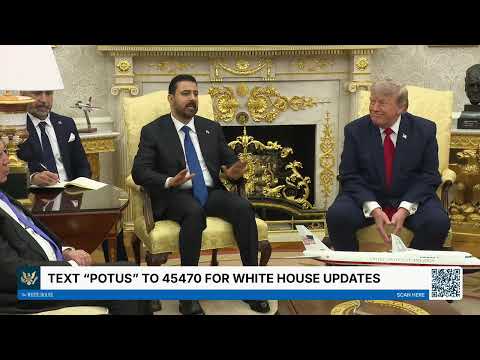
At a White House event, the visiting prime minister of Iraq said U.S. forces would be out of Iraq by Sept. 30 while he and President Trump highlighted major U.S.-Iraq energy partnerships and a plan to restrict weapons to state control.
President Trump and the visiting prime minister of Iraq discussed a planned U.S. troop withdrawal, expanded energy partnerships and Iraq’s internal security plans during a White House press event.
The visiting leader, identified in the transcript only as the prime minister of Iraq, said, “By the September 30, The US forces will be out of Iraq,” and described the visit as “an announcement of economic partnership” with U.S. companies remaining to do business in Iraq. President Trump framed the relationship in economic terms, highlighting Iraq’s “tremendous oil reserves” and saying American firms were signing major partnerships and “creating a lot of jobs for both countries.”
Why it matters: The statements combine a security timetable (a Sept. 30 withdrawal date stated by the prime minister) with promises of large-scale commercial engagement by U.S. companies. Changes to troop posture and extensive energy deals would affect bilateral security cooperation and Iraq’s reconstruction financing.
Security and internal reform: The prime minister told the press that his government’s program is to “restrict the position of weapons to the state,” adding that factions that surrender arms could be absorbed into political or civilian life. He characterized that approach as a decision rather than an option, saying, “We never accept for any entity to carry weapons outside the control of the [s]tate.”
Economy and energy: President Trump said Gulf partners had offered to invest in the United States rather than pay fees for protection of shipping routes, a change he welcomed. A reporter noted about $110,000,000,000 in deals signed by the Kurdistan regional leadership with U.S. firms; the prime minister said Baghdad and Erbil cooperating could expand that investment. The transcript includes a statement attributing reconstruction damages in Iraq of "more than 400, billion dollars"; the exact phrasing and punctuation in the transcript are as quoted and may reflect imprecision in the spoken figure.
Exchange highlights: Reporters pressed the leaders on OPEC, the possibility Iraq might seek a larger OPEC share or leave, and on coordination between Baghdad and the Kurdistan Regional Government. President Trump said he supported the prime minister’s push for changes and recalled having endorsed him early in the campaign that led to his election victory.
What was not decided: The remarks recorded in the transcript are public statements of intent and assertions of policy and partnership; the transcript does not include signing of binding agreements, formal enactments or a timeline of implemented contracts. The Sept. 30 date for U.S. forces is presented in the prime minister’s remarks; the transcript does not provide supporting documents or legislative actions implementing a withdrawal.
Next steps: Both leaders emphasized continued cooperation; President Trump arranged an unscheduled lunch to continue discussions, and the prime minister framed future cooperation on security and investment as a priority.