Get Full Government Meeting Transcripts, Videos, & Alerts Forever!
Get email alerts on the Noise topic
No spam. Unsubscribe anytime.
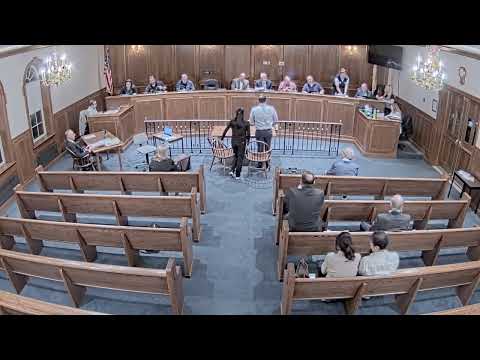
Hearing on Colonial Manor's outdoor ceremonies continues after acoustical and landscaping testimony
Summary
Acoustical engineer said modeled daytime sound from amplified speakers and crowds would meet DEP limits with proposed 8'12-foot barriers and a speaker limiter; residents pressed for event-time measurements. The board carried the hearing to Oct. 30 for one remaining witness.
The planning board heard detailed acoustical and landscaping testimony in the continued Colonial Manor application for limited outdoor ceremonies but did not decide the application and carried the hearing to Oct. 30.
Acoustical engineer Matthew Morello told the board his firm modeled amplified music and speech using SoundPlan software and the New Jersey Department of Environmental Protection daytime threshold of 65 dBA at a residential receiving property line. He said the proposed sound system would be fitted with a limiter set so the speakers cannot exceed 75 dBA at 3 feet; combined with proposed acoustical barriers (8 feet on the north and west, 12 feet on the south) the model predicts the property line would be under the 65 dBA limit in typical daytime scenarios. "With that barrier and the proposed operations during daytime hours, we expect to meet the daytime code in all scenarios," Morello testified.
Morello also described baseline measurements taken at the property line (continuous readings from noon to 7 p.m. on a site visit, with averages between roughly 44 and 50 dBA and maximum short-term ambient spikes to 55'68 dBA). He modeled an extreme scenario with nearly 300 people shouting simultaneously and said the peak at one point on the property line could briefly reach about 66 dBA behind the barrier but fall to about 60 dBA at the nearest house; he added a 1'decibel difference is nearly imperceptible and that a 3'decibel change is the typical threshold for perceptible difference.
Board members pressed for practical testing during an actual outdoor event and asked whether barrier placement, height, and limiter tamper-resistance would be enforceable; Morello said the limiter is typically secured and not user-adjustable and that barriers work best placed close to the source. Several residents described recent outdoor noise they experienced and asked for event-based metering. The landscaping witness, Paul Keyes, described layered evergreen buffers, flowering trees and laurels to reduce light spill and screen adjacent properties; board members noted the plantings would complement the sound barrier.
Why it matters: The application would allow limited outdoor ceremonies at a venue adjacent to residential neighborhoods; noise and visual screening are central community concerns.
What comes next: The board carried the hearing to Oct. 30 to hear one remaining witness and to allow the applicant to address follow-up requests from the board and residents.