Get Full Government Meeting Transcripts, Videos, & Alerts Forever!
Get email alerts on the Old City Hall topic
No spam. Unsubscribe anytime.
Council workshop weighs demolition, short‑term lease or parking expansion for Old City Hall
Summary
City staff presented three narrowed options for the 1986 Old City Hall — demolish and add parking, hold and monitor the adjacent school site for a coordinated master plan, or lease the building — and highlighted deferred repairs estimated at more than $800,000. Councilors leaned toward keeping flexibility via short leases or temporary parking while the school site outcome is settled.
City staff brought the future of Old City Hall to a council workshop, presenting three narrowed options — demolition and expanded parking, leasing the building to a private tenant, or preserving the site while coordinating a master plan with the adjacent school property — and said deferred maintenance already exceeds $800,000.
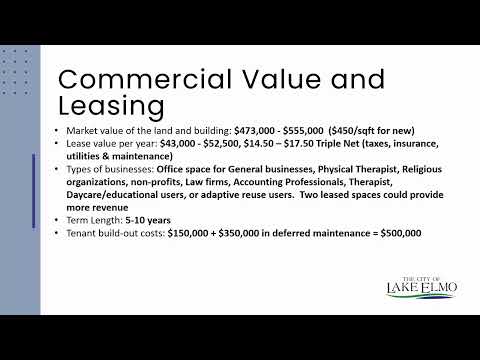
The discussion matters because the one‑and‑a‑half acre property sits near an undeveloped school site that could influence long‑term reuse. Staff said a demolition plus formal parking‑installation concept would add roughly 40 spaces; the packet contained a rough demolition estimate of about $35,000 and a preliminary demo‑plus‑parking figure of approximately $291,000.
Staff emphasized the building’s age and systems needs. “The repairs are over 800,000,” the staff presenter said, listing HVAC, electrical and site work as primary drivers of cost. Broker Scott Cragnus of Metro East, who prepared a broker price opinion for the council, warned that new construction costs are high and that leasing the building would require tenant improvements. “Really high build cost,” Cragnus said, adding that triple‑net leases can transfer many maintenance costs to tenants but often require significant early investment by the owner or tenant.
The broker and staff walked through a lease scenario that showed modest first‑year gross rental income (presented as roughly $43,000) and a negative initial cash flow when debt service and early capital needs are included; those numbers improve in later years if rents and property values appreciate. Staff noted the modeled debt service assumed long amortizations (30 years) and interest rates used as examples of about 5–6 percent.
Council members pressed staff on leaseability and code compliance. The fire chief and development staff cautioned that long vacancy can trigger code upgrades; staff said some office uses could be grandfathered while a change to retail or assembly likely would force accessibility and building‑system improvements. “If it’s retail, it’s a different story,” the broker said when asked about potential tenant types.
Several councilors argued against entering a long‑term property management role for a small net return. One councilor noted the city could earn only a few thousand dollars per year in the early years under a leasing scenario and described the prospect of property management for marginal revenue as “no fun.” Instead, a number of councilors favored short‑term, flexible approaches — a one‑to‑three‑year lease or demolition followed by a temporary gravel parking surface — while the adjacent school site and community group plans (discussed as the “Fury” or school parcel in the record) are resolved.
Staff said they will meet with the school district and relevant stakeholders and scheduled a workshop in September to discuss joint planning for both properties. No formal motion or vote was taken at the workshop; staff were asked to return with refined options, code implications for potential tenants, and estimates for a temporary gravel solution if the council wishes to preserve flexibility.