Get Full Government Meeting Transcripts, Videos, & Alerts Forever!
Get email alerts on the Jlarc Study Selection topic
No spam. Unsubscribe anytime.
JLARC studies subcommittee narrows next year’s slate to K‑12 accreditation, corrections education, capital assets and two‑year colleges
Summary
The Joint Legislative Audit & Review Commission studies subcommittee reached consensus to ask staff to draft study resolutions on K‑12 accreditation changes, correctional education programs, the state capital asset management system and Virginia’s two‑year institutions; a gun‑violence study is already directed by joint resolution.
The Joint Legislative Audit & Review Commission studies subcommittee agreed by consensus to forward four topics for staff to draft study resolutions, Marcus Simon, the subcommittee chair, said during a morning meeting (date not specified). The topics are K‑12 accreditation changes, correctional education programs, the state capital asset management system and Virginia’s two‑year (community college) institutions; a separate gun‑violence study was already directed by joint resolution earlier this year.
Justin Brown, an associate director at JLARC, told members the commission typically conducts five studies and that staff would draft resolutions for the items the subcommittee selected and return them for review before the full JLARC meeting in November. “We can normally do five studies,” Brown said; because a gun‑violence review is already on JLARC’s docket, the subcommittee was choosing the additional topics to fill the remaining slots.
The subcommittee discussed the scope and rationale for each item. On K‑12 accreditation, Brown said staff would examine how recent changes to the accountability system work in practice and the implications for school divisions. Members referenced concern from school officials that the new system has left a large share of schools “off track” under the revised criteria; one member said the issue has generated “the ire of a lot of folks.”
Members also endorsed a study of correctional education programs to assess how education and vocational training are provided across local jails and state correctional facilities and whether programs are delivered early enough to support reentry. Senator Locke argued the work should explore timing: “Is it a month before a person is to be released? Or is it day one upon being incarcerated?” he said, adding his view that programming should start at intake when appropriate.
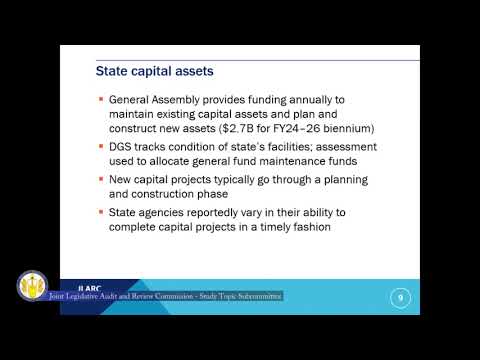
Staff proposed examining the state capital asset management system to evaluate data on facility condition, how maintenance and new projects are prioritized, and whether current funding and planning processes delay construction. A member noted that spreading resources across too many concurrent projects can slow delivery, while another said: “If you have a capital plan that people can depend on, this is gonna come.”
The subcommittee also asked JLARC to review two‑year institutions — enrollment trends, transfer pathways, alignment with employers and the role of dual or concurrent enrollment with high schools. Members emphasized variation across regions and opportunities to help families and students reduce time and cost to credentialing through better coordination between high schools, community colleges and employers.
On several proposals members urged staff to coordinate with existing work or outside studies before launching a full JLARC review. For example, Brown said the Cannabis Control Authority had commissioned a market review of the medical marijuana program; members suggested JLARC first review that work to decide whether additional study is needed.
Brown told members staff would draft study resolutions reflecting the subcommittee’s direction and return them for editing and approval, likely at the November full JLARC meeting. Marcus Simon adjourned the subcommittee so members could reconfigure for the full commission meeting.
The subcommittee’s decisions were taken by consensus during this meeting; the staff will present draft resolutions and any required procedural motions to the full commission in November.