Get Full Government Meeting Transcripts, Videos, & Alerts Forever!
Get email alerts on the Traffic Calming topic
No spam. Unsubscribe anytime.
Nashville residents oppose proposed speed cushions on Morton Mill Road; staff outlines ballot process
Summary
At a neighborhood meeting, traffic-calming staff presented a design that would place four speed cushions on Morton Mill Road. Nearby residents raised noise and placement concerns, urged alternatives such as radar feedback signs or enforcement, and questioned proceeding without the applicant present. Staff said vertical measures would require a mailed household ballot with a 66% yes threshold.
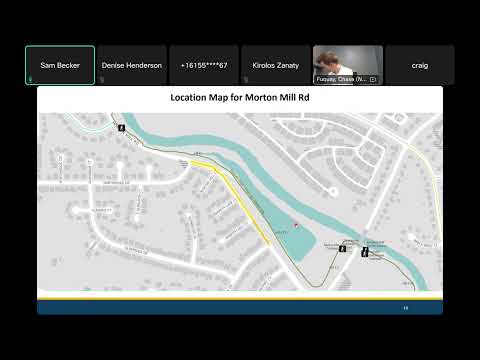
Staff from Nashville’s traffic calming program presented a preliminary plan on Morton Mill Road that would place four speed cushions and several non‑vertical alternatives, but many nearby residents voiced opposition and asked staff to pursue less intrusive measures.
Chase, a traffic calming staff member who led the meeting, said the program focuses on residential streets and physical measures intended to lower speeds and reduce serious crashes consistent with the Safe Systems approach and the city’s Vision Zero goal. He said data collected for Morton Mill Road showed an 85th‑percentile speed of about 37 miles per hour on a posted 25 mph corridor and daily traffic volumes above 3,000 vehicles, and that the roadway is roughly 36–38 feet wide with a center turn lane.
The data, Chase said, informed a proposed concept of four evenly spaced speed cushions — roughly one per block — though two locations were flagged as candidates for a chicane (a horizontal deflection) instead. “This is a proposed concept,” Chase said; he paused the presentation to solicit residents’ lived experience and feedback.
Residents who spoke opposed cushions placed near homes because of potential noise and repeated vehicle impacts. “My bedroom is right here off of the road,” Denise, a resident, said. “When you put a speed bump up and it’s directly out in front of my house, the noise of a car hitting there continually all day long — that’s going to be a noise issue within my home.”
Other residents echoed concerns that cushions would create persistent noise for houses 20–30 feet from the roadway. Several participants said they would prefer stepped enforcement or electronic speed‑feedback signs before adding vertical measures: “I’d probably rather see someone — or see, you know, more speed signs, maybe a radar sign put up — before jumping to speed cushions,” Sam, a resident, said. Craig, another resident, suggested police enforcement could be a better use of funds than physical cushions.
Chase said some non‑vertical tools, such as radar speed‑feedback signs, are commonly used and would not go to a neighborhood ballot, while vertical measures (speed cushions) are subject to a mailed household ballot. He said the program sends ballots by mail to properties above the right of way, that the online voting period is six weeks, each household gets one vote, and two‑thirds (66%) of respondents must vote yes for a vertical project to move forward. Staff also said they would follow up on legal questions raised about automated camera enforcement; Chase said he believed camera ticketing is likely not permitted under Tennessee law and would confirm.
Several residents emphasized that the person who submitted the application was not on the call and urged staff to consider pausing action until that applicant’s reasoning could be heard. Chase said staff would take the feedback, perform field verification, revise designs as needed, and return for a second meeting before any ballot. He provided contact information (trafficcalming@nashville.gov) and directed residents to trafficcalming.nashville.gov and the public input page on engage.nashville.gov for further comments.
The meeting closed after residents asked for clarification about the ballot and next steps; staff committed to follow‑up and to present a revised design at a subsequent neighborhood meeting.