Get Full Government Meeting Transcripts, Videos, & Alerts Forever!
Get email alerts on the Transfer Station topic
No spam. Unsubscribe anytime.
Tamworth residents press Select Board on dump rules as recycling building work continues
Summary
At a July 14 meeting, residents complained about transfer-station staff conduct and unclear rules; the Select Board discussed clarifying guidelines (pet waste, diapers, 'first $5' rule), accepted an EV-charger donation, and reviewed progress and delays on recycling equipment and a proposed truck scale.
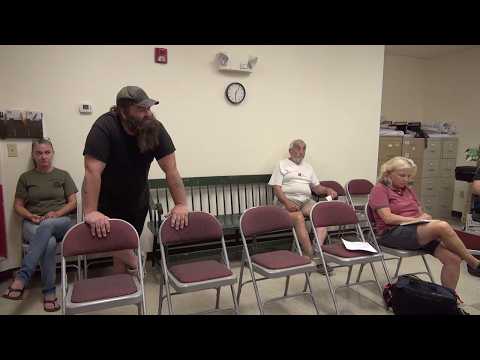
Daniel McDonald, a Tamworth resident, told the Select Board he was singled out at the transfer station after an attendant insisted he remove a small piece of plastic from his trash and said staff were rude. "I'm a taxpayer in this town…to be treated like this is a dump," McDonald said during public comment, adding he has heard similar complaints from others.
Select Board members responded that the board has not previously received a formal written complaint about the incident and urged residents to submit written reports so the town has a record. A Select Board member said, "You're the first person who's come to the Select Board with a complaint," and encouraged follow-up so staff can investigate and the board can act.
Transfer-station staff described operational reasons for the interaction. A staff member apologized for any perceived rudeness and said employees are working to divert inappropriate items from the compactor to protect equipment. "We're not trying to get you to recycle. We're trying to just divert it from the compactor container," the staff member said, describing efforts such as asking users to sort bulky items into a construction container when appropriate and offering the first $5 of bulky waste free to residents.
Board members and residents asked whether the town records video of the compactor area and how to obtain it. A board member clarified, "There is no audio to the cameras," and said the posted camera angles may not capture every area residents ask about; requests for copies would be handled through normal town procedures.
Much of the public discussion focused on how to reduce subjectivity in enforcement and make rules clearer. The board discussed a range of policy clarifications, including whether diapers and double‑bagged pet waste should be expressly allowed, how to define "bulky waste" (a suggestion was to use a standard bin or bucket size), and whether some construction debris should be charged differently. Staff reported that state guidance from the Department of Environmental Services (DES) said disposal of pet waste is not prohibited at the state level but a town may adopt its own rule; the board leaned toward allowing diapers and double‑bagged pet waste while updating the local guidelines to remove outdated text and point residents to regional hazardous‑waste schedules.
The board also received updates on transfer‑station infrastructure: the recycling building shell is painted and graded, but the baler contractor said the baler was ordered late and may not arrive by the end of the month; getting the baler through the building will require partial dismantling. Separately, the town has bids for a truck scale but has not yet secured electricians to run power and communication cabling, and underground cabling could complicate siting and installation. Board members said the scale would improve fairness for contractors but could require extra town work (trenching, cabling, ramps), and they discussed whether to pursue paving or a scale depending on grant reimbursement possibilities.
Financial and procedural actions tied to the transfer station also appeared on the agenda. The board accepted an additional $7,409 in donations for an EV charging station and agreed to add the funds to the town's energy improvement trust; the total fundraising goal was reported at about $22,000 and the energy committee is negotiating installer pricing.
The board asked staff to draft clearer, interim signage (even a temporary taped poster) to explain bulky‑waste vs. construction debris and the first‑$5 policy while a fuller guideline revision and public rollout are prepared. Several members emphasized the goal of consistent, transparent enforcement to reduce disputes and equipment damage.
What happens next: the board asked staff to (1) collect any formal written complaints from residents, (2) consolidate duplicate guideline documents currently posted online, and (3) return with proposed wording changes to the transfer‑station guidelines for future consideration and a wider public rollout when the recycling facility is operational.