Get Full Government Meeting Transcripts, Videos, & Alerts Forever!
Get email alerts on the Sewer Rates topic
No spam. Unsubscribe anytime.
Tyngsborough sewer rates to rise through FY29 as town seeks reserves and covers steeper intermunicipal charges
Summary
Town officials at the July 13 Select Board meeting described sharp increases in charges the sewer utility pays other towns and aging equipment costs as drivers of planned multi‑year sewer rate increases that the Sewer Commission set for FY27–29. Officials said the increases aim to restore emergency reserves and fund capital replacements rather than shift general‑fund burden to taxpayers.
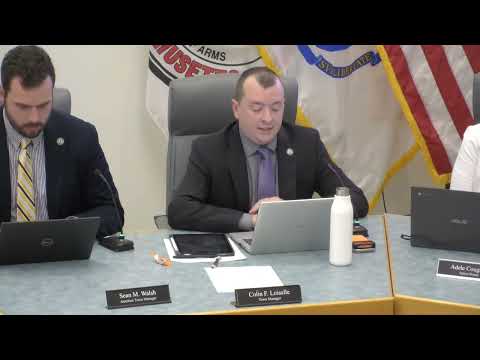
At its July 13 meeting, the Tyngsborough Select Board received a detailed presentation from DPW Superintendent Jacobs Woodard and Sewer Administrator Kathleen Keier explaining why the town’s sewer rates will rise through fiscal 2029.
Keier said the Sewer Commission’s rate recommendations follow Massachusetts Department of Revenue best practices for “full‑cost recovery,” meaning user fees should cover operation and maintenance, capital, debt service and an emergency reserve. “We’ve been hit really hard,” Keier said, listing rising vendor, energy and replacement costs and pointing to examples such as an $80,000 price tag for a single large pump and roughly $46,000 a year to manage odor control for 17 pump stations.
The presentation said intermunicipal‑agreement (IMA) charges that Tyngsborough pays to neighboring systems were a major driver. Keier explained that Lowell sets a per‑million‑gallon rate that feeds through to other towns: “From fiscal ’25 to ’26, both Dracut and Lowell rates increased about 55 percent,” she said. “Those are not small numbers — these are payments of hundreds of thousands of dollars a year.” Woodard added that Dracut typically re‑bills Tyngsborough by adding roughly 15 percent to Lowell’s rate as part of longstanding contracts.
To manage those structural pressures, the Sewer Commission decided to spread an otherwise steep immediate increase across three years so ratepayers can plan. Keier described the mechanics: residential customers pay a flat annual user fee (because not all residences have municipal water meters), while commercial customers are billed based on meter readings. The town has roughly 2,235 sewer accounts in the system; commissioners and staff estimated residential accounts represent about 75 percent of usage and revenue.
Keier also described the Commission’s reserve policy: the goal is an emergency reserve equal to about 25 percent of annual O&M plus an amount equal to the cost to replace the largest capital item (the presentation used a $150,000 benchmark). She said retained earnings have been drawn down over years of holding rates steady and that the Commission must rebuild reserves to avoid coming to the general fund for unplanned emergency repairs.
Board members asked detailed operational and fairness questions: how IMA charges are calculated (Keier said Lowell’s rate is allocated by flow and cost, and Dracut and Chelmsford apply different billing units), how the three‑year phase mitigates sticker shock, and why residential fees are flat. Keier reiterated the equity rationale: many homes use private wells and cannot be metered reliably, so a flat user fee keeps billing consistent across the residential base.
Keier said commercial customers will see rate changes beginning with their July billing cycle and that residential bills reflecting FY27 rates will appear in the September statement (covering July–December) and in March (covering January–June). She confirmed the Commission has no formal hardship program in place now but that commissioners have discussed options, including spreading residential charges quarterly to ease cash flow for households.
What happens next: the Sewer Commission has set the three‑year schedule for FY27–29; the Select Board’s meeting heard the public explanation and asked for ongoing outreach. Keier encouraged residents to call the sewer office with questions and said the department will publish clear billing and program information ahead of the September residential bills.
The administration framed the increases as a move to financial sustainability for the enterprise fund and to reduce the town’s exposure to major emergency repairs and steep intermunicipal cost swings. The Select Board did not vote on the sewer rates at this meeting; the changes reported were those approved by the Sewer Commission and will be reflected on upcoming bills.
Ending: sewer bills for residential customers reflecting the new fiscal‑year rates will be mailed in September; commercial bills reflecting the new schedule start earlier in July.