Get Full Government Meeting Transcripts, Videos, & Alerts Forever!
Get email alerts on the Short Term Rentals topic
No spam. Unsubscribe anytime.
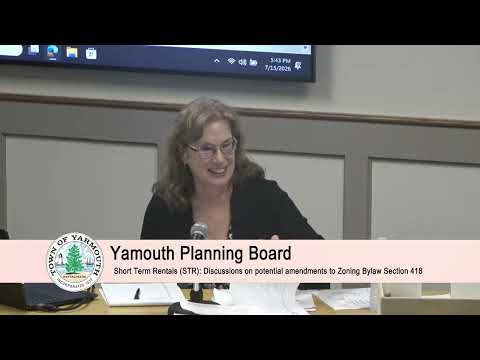
Yarmouth planners press for online complaint form, tighter rules and clearer appeals in short-term rental draft
Summary
Planner Kathy Williams recommended an online complaint form, clearer appeal routes and more owner education as the Planning Board continued its review of draft short-term rental rules; residents urged stronger enforcement and alternatives for counting complaints.
The Yarmouth Planning Board on July 15 continued deliberations on a revised short-term rental ordinance, with town planner Kathy Williams outlining staff recommendations including an online complaint form, a one‑page inspection sign-off for owners and clearer procedures for appeals and revocations.
Williams told the board she and staff met on July 13 with Building Commissioner Mark Rills, housing inspectors and Police Chief Lennon and said the chief recommended copying the police traffic‑complaint workflow: “an online complaint form…because it’s easier to log, keep it logged and also to send it to the right people,” Williams said. The proposed form would route serious public‑safety matters (for dispatch) and lower‑priority complaints through an administrative queue for follow-up.
The draft also proposes owner education and inspection sign‑offs that record occupancy limits and on‑site parking. Williams said staff is considering charging a reinspection fee for failed rental inspections to discourage repeat violations. She told the board staff has identified 826 short‑term rental listings in town, with a small share owned by LLCs.
Board members asked whether the ordinance should count repeated lower‑level complaints over multiple years against the same owner. Tom Bell Pendleton and others argued for tools that capture chronic problems; Williams said the town currently requires annual recertification and that revocation is the strongest enforcement tool when chronic or serious violations occur.
The board also agreed to strike a draft sentence that would have allowed daytime occupancy equal to twice the overnight capacity after members warned it could be interpreted to allow large gatherings.
Resident Don Palaya urged the board to make the complaint window a calendar year rather than a six‑month period and said enforcement feels weak: “There’s no enforcement on anything,” he said, adding that neighborhood maintenance disparities frustrate longtime residents.
The board did not take a final vote on the draft. Members asked staff to refine the complaint form proposal, clarify the appeal path (rental‑certificate appeals to the select board; certificate‑of‑inspection appeals to the building code appeals board), and return with redlined language and input from town council.