Get Full Government Meeting Transcripts, Videos, & Alerts Forever!
Get email alerts on the Yale Manchester Reinvestment topic
No spam. Unsubscribe anytime.
Maplewood staff outline Yale–Manchester 'quick wins' and longer programs after resident meetings; council debates 'armed' benches
Summary
Staff summarized four community meetings for the Yale–Manchester area and proposed about $250,000 in near‑term city investments and design work (plus $9.5 million in expected grants/private leverage) for lighting, bus‑stop relocations, traffic calming, cameras, programming and a mobile‑vendor pilot; councilors split over accepting benches with center arms that some called 'hostile architecture.'
City staff presented the results of four community meetings about the Yale–Manchester neighborhood at the Maplewood City Council work session on Tuesday and asked the council for buy‑in on a package of short‑term “quick wins” and longer place‑making investments.
“My name is Celeste Gray. I'm the social service coordinator for Maplewood and Richmond Heights,” said Celeste Gray, who summarized resident and business feedback gathered at three resident sessions and one business meeting at 2286 Yale. Gray said recurring themes were strong local ties, support for Black‑owned businesses, and shared concerns about gun violence, open‑air drug activity, speeding and uneven sidewalks.
Staff told the council the recommendations include roughly $250,000 in near‑term city investment over two fiscal years and an anticipated $9.5 million in grant and private investment to leverage design and construction. The immediate proposals emphasize transit changes, lighting, traffic calming, parking and programming. “Over those two fiscal years, we're proposing almost $250,000 in investments,” a staff presenter said.
On transit, staff recommended moving two bus stops so they back up to crosswalks (reducing parking conflicts) and adding grant‑funded benches: about 12.5 daily boardings were reported at one stop and almost 18 at the south‑side stop. Staff recommended accepting bench donations from Citizens for Modern Transit (CMT) but declined a single unarmed bench offered by CMT for the Yale location because residents at 2286 expressed concern that unarmed benches could encourage overnight sleeping outside their doors.
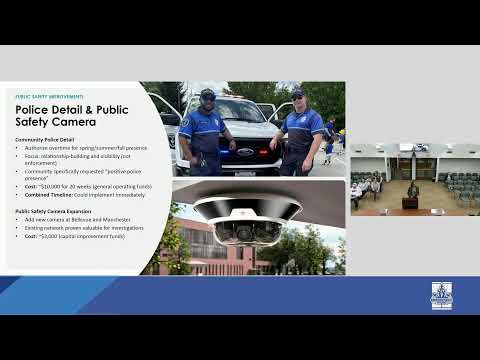
Staff also proposed adding two to three solar streetlights (each unit about $4,000 plus approximately $3,000–$4,000 for installation), low‑intensity traffic‑calming measures this fiscal year, and an additional public‑safety camera at Bellevue and Manchester. The proposal included more frequent community programming — block parties and a monthly mobile food market the city plans to begin in April — and options for a small public‑private cafe or rotating food‑vendor model at the Yale bus‑loop area rather than a permanent building.
On policing and enforcement, staff said additional community police detail would require overtime from existing officers and estimated roughly $500 per week for the detail. Staff emphasized the city’s different approaches to park ordinances and bus‑stop areas and noted that Celeste Gray’s role includes connecting people who sleep outdoors with alternative shelter options when appropriate.
Councilors probed equity questions raised by residents who said apartment dwellers often feel excluded from nearby green space. “One resident mentioned that they felt like it wasn't used properly,” Gray said, describing reports that apartment residents were at times told not to go to the nearby park. Council members discussed programming, more inclusive scheduling and ways to adjust existing events to welcome the Yale–Manchester neighborhood.
The agenda also included an update on the Maplewood Loop Apartments: staff said the sale had cleared HUD transfer approvals and the developer presented preliminary renderings for 89 renovated units; the developer plans to use historic tax credits for the former theater at 2286 Yale and may seek a Chapter 353 construction‑materials tax abatement if it proceeds. Staff noted the city had provided a prior letter supporting low‑income housing tax credits.
The meeting’s most contested exchange centered on bench design. One council member identified in the record as Council member Wylie objected to installing benches with a center arm — often called hostile architecture — saying it sent the wrong message. “I am simply fundamentally against the installation of hostile architecture,” the council member said, urging acceptance of an unarmed bench that CMT offered at no cost. Other members and staff countered that some residents had asked for bench styles that discourage lying down near fast traffic and that safety near Manchester was a concern.
Staff said the bench decision could be handled as part of lease negotiations or design work and that the master plan for the Yale Green Space already spec’s covered seating; staff recommended accelerating design work with SWT so implementation could begin next fiscal year. They also said there is unused capital‑improvement money this year that could cover some of the quick wins and that budgeting for future years will take place in the spring process.
Next steps: staff requested council feedback and 'buy‑in' to continue design, lease and grant conversations and to move forward on scoping traffic, lighting and programming work. The council recessed the work session at 7 p.m. and moved to a five‑minute recess before the regular meeting.