Get Full Government Meeting Transcripts, Videos, & Alerts Forever!
Get email alerts on the Transportation topic
No spam. Unsubscribe anytime.
NDOT outlines Arthur Avenue traffic‑calming concepts as residents weigh cushions, chicanes and circles
Summary
NDOT presented a preliminary traffic‑calming plan for Arthur Avenue in Nashville on June 25, covering speed cushions, bulb‑outs, chicanes and traffic circles. Staff will conduct a site visit, develop designs and return for a second meeting before a mailed ballot for any vertical measures.
David Greaves, a facilitator with NDOT's traffic‑calming program, presented a preliminary concept for Arthur Avenue on June 25, describing data showing an average speed of about 31 mph and roughly 1,800 vehicles per day and outlining a toolbox of possible treatments including speed cushions, bulb‑outs, chicanes and traffic circles.
The meeting matters because Arthur Avenue is an arterial connector with recorded crashes and observed high speeds that neighborhood residents said pose risks to people walking and biking. Greaves tied the work to a safe‑systems approach and Nashville's Vision Zero aim to reduce fatal and serious traffic injuries.
Residents at the virtual meeting described repeated rolling through the four‑way stop at Arthur and Cheatham and regular speeding along the stretch under the interstate. "We notice very high speeds, lots of times, as well as people ignoring the 4‑way stop," said Robin White, who identified herself as a resident at 1407 A Arthur Avenue. Jason, who said he serves as a neighborhood beautification chair and was observing from his front yard, said, "we are actually sitting out in our front yard now watching people roll through continuously." Several participants asked NDOT to prioritize treatments that would slow vehicles before the underpass where visibility is limited.
Greaves reviewed the agency's evidence base: vertical measures such as speed cushions and speed tables are supported by local before‑and‑after data; he said a 2025 NDOT review of installed projects showed an average speed reduction of about 9 mph. He described differences between cushions (modular devices with gaps for emergency vehicles) and speed tables, and said radar feedback signs and striping to visually narrow lanes are alternative, non‑vertical options.
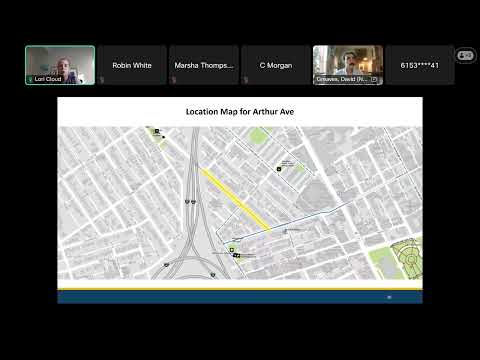
On the draft concept map, NDOT proposed bulb‑outs near Garfield Street, an initial set of speed cushions north of Garfield and additional cushions between Cheatham and Monroe, while acknowledging that cushions can reduce on‑street parking and that chicanes or pinch points would also affect parking and bike‑lane continuity. Greaves said the project's current application limits are Garfield to Monroe but that the team could evaluate extending study limits to include the underpass area, where a prior tactical art installation had created a de‑facto chicane.
A longtime resident raised the possibility that short‑term rentals might contribute to risky driving behavior, asking whether turnover and Airbnb guests could be a factor. Greaves said the majority of the roughly 1,800 trips appear to be through traffic, not trips to or from homes on Arthur, and called the source of trips outside the project's primary purview for policy changes.
Greaves outlined the next steps: NDOT will perform a site visit, sketch circle and pull‑out concepts, coordinate with partners working on a public‑art installation under the underpass, post design options online and likely hold a second neighborhood meeting. He explained that any proposed vertical measures would go to a mailed ballot (six‑week period) to property owners and eligible addresses; vertical measures require approval by two‑thirds of respondents for implementation. Vacant properties and commercial businesses are excluded from the vote; each residential property, church and school gets one vote.
The meeting closed with staff promising follow up communications and a participant identifying herself as the meeting secretary asking to be emailed about the second meeting. Greaves said NDOT will coordinate with neighborhood representatives and other city partners as the team moves to design and ballot steps.