Get Full Government Meeting Transcripts, Videos, & Alerts Forever!
Get email alerts on the Subdivision Rules topic
No spam. Unsubscribe anytime.
Erath County reviews major rewrite of subdivision rules; commissioners debate drainage thresholds, road widths and fees
Summary
County staff presented a wide-ranging rewrite of Erath County's subdivision rules to simplify wording, add a minor-plat option and update technical standards. Commissioners pressed staff on a 64-acre drainage threshold, road-width standards and fee consolidation as staff pledged follow-up work with groundwater modelers and state agencies.
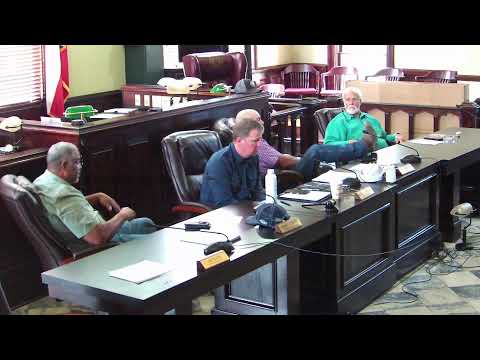
Erath County Commissioners Court reviewed a draft overhaul of the county's subdivision rules at a July 15 special session in Steamboat, with staff framing the changes as reorganization and clarification rather than broad new restrictions.
Presenter (Speaker 2) said the package is the result of a two-year process that reorganizes the existing rules into clearer sections and adds user-oriented tools, including a color-coded redline and a flowchart on the land-development website. "The ones on the left are the provisions that we're referring to this morning ... there's a lot of information in here," Speaker 2 said, adding staff plans to publish a step-by-step flowchart so prospective developers can see what to expect.
The draft adds a new "minor plat" pathway for small, adjacent unplatted parcels that do not require road construction. "If it's 4 or fewer lots, they can actually change that, and we can do it as a minor plat where there's not a lot of ... road construction," Speaker 2 said. Staff said minor plats are intended for record-keeping and to simplify the process for low-impact changes.
Drainage standards drew the sharpest questioning. Commissioners criticized a 64-acre drainage reference in the draft. "64 acres isn't very big," Speaker 5 said, urging staff to raise the threshold or avoid a single hard number because drainage impacts vary by geography. Staff and other commissioners advised using available modeling and “credible evidence” maps rather than an arbitrary cutoff; Speaker 6 described differences between older one-dimensional mapping and newer models and urged further work with local groundwater experts.
Commissioners also discussed road-width and shoulder standards. The draft carries over a 2022 standard that effectively yields a 28-foot travelway with 4-foot shoulders. Several members asked staff to consider a narrower design for typical local roads—proposals floated included a 24- or 26-foot base—while keeping a 60-foot minimum right-of-way to preserve future options for connectivity.
The court spent substantial time on fees and inspection charges. Staff outlined current calculations—examples included a Part A application fee of $500 plus $30 per lot, construction-phase charges tied to road length (about $1 per foot in the draft) and an inspection fee of 2.5% of construction costs—and proposed consolidating some charges so applicants write fewer checks. "I don't want current taxpayers paying for the developers cost," Speaker 1 said, arguing development should cover program costs without creating unaffordable barriers to housing.
Staff also proposed clarifications that would align the rules with state processes: a definition of OSSF (on-site sewage facility) and tentative language tying septic permitting to compliance with county rules, which staff said they will verify with the state before keeping in the final draft. The county will revisit suggested changes with Trinity/Groundwater mapping staff and return with refined language on groundwater "credible evidence" and on whether county edits can be enforced through state permit controls.
The county recessed for a short break and planned further edits based on today's discussion. Staff said they will return revised fee language, suggested drainage thresholds informed by modeling, and final technical text on roads and RV-park spacing for the court's future consideration.