Get Full Government Meeting Transcripts, Videos, & Alerts Forever!
Get email alerts on the Charter Review topic
No spam. Unsubscribe anytime.
North Miami Beach commission opens detailed review of charter committee recommendations
Summary
The charter review committee presented a redline of proposed changes and the commission agreed to consider items section-by-section. Commissioners debated measures ranging from developer-data requirements and official duties to whether items should go to the November ballot.
The North Miami Beach City Commission opened a detailed line-by-line review of a charter review committee report on Wednesday, debating dozens of proposed changes and agreeing to consider items by grouped sections.
The committee asked to present its final report and recommended that the commission set time limits for the presentation; Mubarak Kazan, chair of the charter review board, asked that David Templar speak for the panel and said the committee had met nine times in two months to prepare the redline draft. The commission voted to review the submission by sections and to decide what changes to put to voters rather than adopting the entire package wholesale.
The committee’s redline added a paragraph to Article 1.4 focused on requiring the city to make written findings and to rely on “current and reliable data” when considering development agreements. Bruce Cousins, a committee member, told the commission he had recommended adding language because some development materials used outdated flood maps; he said the change would require staff and the commission to base decisions on up-to-date analyses.
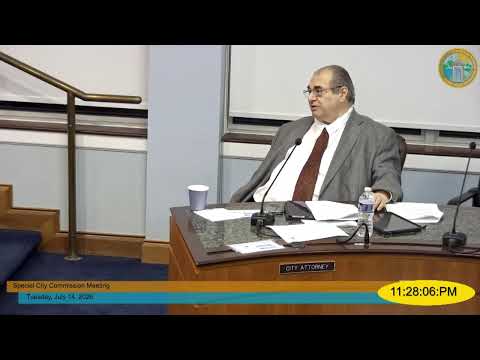
City Attorney Geller advised that much of the proposed language is legal elaboration rather than novel duties, and that some items could be handled by ordinance. “Whether you need to state that in your charter is questionable,” Geller said, adding that the city attorney’s office did not object to the proposed language.
On process, commissioners debated whether to vote on every proposed change individually or by sections. Commissioner Jean moved to consider items in groups (for example, pages 10–14, 16–19 and 21–23) and to vote on each section’s items after discussion; the motion passed, allowing the commission to proceed methodically.
Among the specific changes discussed were modified mayoral duties; a proposed codification of the vice-mayor rotation; new requirements for written findings when considering major development actions; an expanded list of unclassified administrative positions; and a committee-proposed ability for the manager to commission independent technical reviews at the applicant’s expense.
The manager and multiple commissioners flagged the difference between policy that belongs in ordinance and what should be frozen in the charter. Commissioners repeatedly asked staff and the committee to clarify which changes were substantive and which were stylistic so the commission could decide what to put on the ballot. The meeting concluded with votes on several procedural and ministerial items and guidance to staff on drafting ballot language for items the commission agrees to advance.