Get Full Government Meeting Transcripts, Videos, & Alerts Forever!
Get email alerts on the Grading Policy topic
No spam. Unsubscribe anytime.
Waunakee policy committee forwards K–12 grading‑policy revisions to full board after debate on middle‑school shift and class rank
Summary
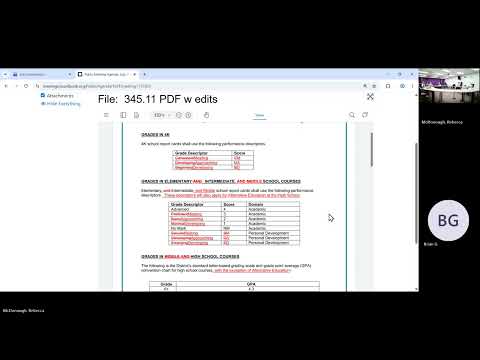
The policy committee voted to forward a revised grading policy that expands performance‑level descriptors across grade levels, keeps traditional high‑school letter grades unchanged, and endorses a three‑year middle‑school transition to standards/evidence‑based grading; the committee also discussed class‑rank reporting and university 'direct admit' implications.
The Waunakee Community School District policy committee voted to approve a draft revision to the district's grading policy and forward it to the full school board for consideration.
Tim (district staff member) told the committee the main change is a retitled, districtwide policy that clarifies the policy applies at all levels — elementary through high school — and extends performance‑level descriptors beyond the high school. "The high school program is maintaining the traditional letter grade system," Tim said, while alternative and competency‑based programs would instead use performance‑level descriptors.
The committee's discussion centered on how the changes would affect middle‑school students. Tim described a planned three‑year transition at the middle school to move from letter grades to a points‑ or standards‑based approach, with course teams developing implementation details and supports for students. He emphasized that credit remains a high‑school concept and that students would not be denied advancement automatically; instead, course placement and workshop supports would be used to address skill gaps.
Members asked about class rank and college‑admissions consequences. Tim said the district has not routinely reported class rank for roughly 15 years but can generate class rank when outside entities (scholarship committees or colleges) require it. He also described how the state 'Wisconsin guarantee' and university direct‑admit processes interact with district reporting and the district's waiver for an alternate ranking method. He noted that, in recent years, "about 75–80%" of graduating students have taken at least one AP course, a shift that affects how honors and senior‑recognition thresholds are considered.
Why it matters: The change aims to align the district with recent state assessment cut‑score adjustments and make grading language consistent across grade bands. For families, the transition will require clear communication about what performance descriptors mean compared with traditional letter grades and how class‑rank information is produced when needed.
The committee voted to send the revised policy to the full board for action; the motion was seconded and approved by voice vote with no dissent recorded. The committee asked that the administration provide additional details on the middle‑school timeline and the implementation plan before full‑board review.
Next steps: The full school board will consider the policy at a future board meeting; the committee requested staff return with implementation timelines, course‑team guidance, and communications materials for families.