Get Full Government Meeting Transcripts, Videos, & Alerts Forever!
Get email alerts on the Housing Supply topic
No spam. Unsubscribe anytime.
Mark Shields says Grand Forks faces sharp rent growth as housing supply lags
Summary
Consultant Mark Shields presented data showing vacancy near 5% and rent growth of about 31% since January 2022, while participants flagged limits in construction capacity, infrastructure costs and data reliability. Attendees recommended zoning changes, more builder engagement and further analysis of incentive costs and trade capacity.
Mark Shields, a consultant with Practice Strategy Group, told a Grand Forks housing working group that the local housing market is tightening: “So roughly 5% of units in rented units, according to [the apartment association], are vacant as of the 1st quarter of 2026,” he said, and pointed to roughly 31% advertised rent growth in the region since January 2022.
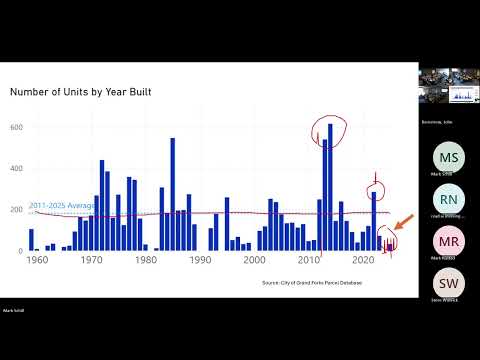
Shields said the city has underbuilt relative to a commonly used 1%‑per‑year equilibrium: Grand Forks has averaged about 181 new housing units annually over the last 15 years while an equilibrium pace for the 2020s would amount to roughly 600 units. He also reviewed home‑sale data (median sale price near $295,000 in 2025) and said MLS listings showed about three months of supply, which he described as a seller‑market benchmark.
Why it matters: participants said the combination of rising rents, low inventory and recent declines in permitted units could hamper workforce recruitment, push lower‑income residents into cost burden and put pressure on the city’s competitiveness in the FM metro area.
Several participants questioned the vacancy estimate’s precision. A Questioner noted that the apartment‑association vacancy measure is voluntary: “there’s no obligation to report that data,” the Questioner said, adding that membership reporting could bias results. Shields acknowledged the vacancy number came from the apartment association’s quarterly survey, and said he drew on multiple sources (Zillow rent listings, city transactions, census data) for other measures.
Participants and builders raised supply‑side constraints. A representative of home builders and the chamber said the biggest near‑term bottleneck is subcontractor labor: “subcontractor labor particularly is very hard to come by in Grand Forks,” the representative said, describing tile, drywall and landscaping as recurring constraints. That view was coupled with discussion of land, lot and infrastructure costs: Shields presented a greenfield example (Grand Valley, ~120 lots) with an estimated $22 million in infrastructure costs, of which about $7 million would be a city investment and the rest assessed to properties.
Incentives and fiscal return: Shields reviewed five past multifamily tax‑incentive deals (examples included a University Flats infill project) and reported roughly $1.3 million in taxes foregone to date and about $1.9 million in new tax revenue generated so far; projected long‑term gains varied by project and incentive design. He stressed outcomes are sensitive to program length, share of taxes foregone and project type.
Policy ideas discussed: participants suggested several options to increase housing production without large public subsidies, including zoning reform to allow missing‑middle housing (quadplexes, townhomes, accessory dwelling units), targeted infrastructure financing (deferring special assessments or lowering administrative fees on large lot developments), modest registration/inspection fees for small multifamily to support enforcement or incentive funds, and actively recruiting builders while surveying local builder capacity.
Next steps: organizers asked participants to send follow‑up ideas by email. City staff and committee organizers said they will circulate the presentation and builders’ roundtable report, consider surveying local builders on capacity, and bring best practices from comparable communities to the next meeting.
The working group did not take formal votes or adopt policies during this meeting; discussions will continue and staff will propose agenda items for follow‑up.