Get Full Government Meeting Transcripts, Videos, & Alerts Forever!
Get email alerts on the Housing Mutual Self Help topic
No spam. Unsubscribe anytime.
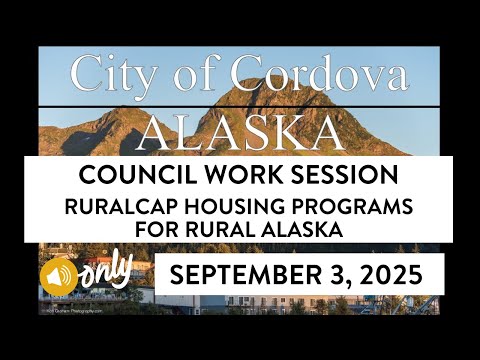
RuralCap outlines USDA "mutual self‑help" homeownership option for Cordova, council hears infrastructure and funding hurdles
Summary
At a Cordova work session, RuralCap representatives detailed USDA-backed homeownership programs — including a mutual self-help model that bundles construction and mortgage financing — and told council members Cordova will need land, collaborative funding and local participants to make an off‑road project viable.
At a Cordova City Council work session on July 16, representatives from RuralCap outlined USDA-backed homeownership and repair programs and discussed what Cordova would need to qualify for a mutual self-help build.
The presentation, led by Michelle French, director of rural housing at RuralCap, and joined by Bob Marquez and Shay Bowman, described the Section 502 direct mortgage and Section 504 repair programs and the nonprofit’s mutual self-help model, in which groups of families build their homes together under RuralCap supervision and finance construction through a single, closed construction-to-permanent loan.
French told the council the Section 502 direct mortgage can require no down payment, carries a fixed interest rate (she cited 5.125% as the current example) that may be subsidized based on household income and offers long repayment terms (up to 33 or 38 years). She described the Section 504 repair grant (up to $10,000 for homeowners age 62 and older) and loan options (up to $40,000) and noted a separate disaster repair grant for 2022 presidentially declared disasters that can provide up to roughly $57,920 and be combined with other 504 assistance.
The mutual self-help program, RuralCap said, typically requires a group of homes — RuralCap recommends a nine- to 11-house 'sweet spot' — and substantial participant labor: each family must provide about a 65% labor contribution, which the presenters equated to roughly a 35-hour workweek on the project, with up to half of those hours filled by recruited volunteers. RuralCap also said no participant may occupy a home until all homes in the group pass final inspections and the group finishes construction, which typically takes about 12 months from foundation to completion on an on‑road site.
Why it matters: Cordova is an off‑road community with high shipping and site-development costs, and RuralCap officials warned USDA construction-cost limits mean the project will require local partners, donated or reduced‑cost land, and layered funding to meet program thresholds. Bob Marquez said off‑road communities often need three years or more of planning and partnership building before construction can start. "This thing's probably gonna take 3 years to get to a point where we can actually hammer a nail," he said.
Council members and residents asked detailed questions about eligibility and local fit. French gave example income limits tied to USDA low‑income maxima (she cited an approximate 2026 example of about $147,009 gross per year for a 1–4 person household in the Cordova area and about $180,600 for larger households), noted there is no strict minimum credit score though a FICO of about 640 simplifies underwriting, and said business assets (for instance a commercial fishing vessel held under a business name) are not counted toward the program's personal asset test.
Participants also asked about costs: French said a four‑bedroom self‑help home cost about $307,000 in the Central Kenai Peninsula last year, that similar houses in Kodiak ran about $100,000 higher, and that Seward projects have exceeded $400,000 per unit. She stressed these figures vary by community and that RuralCap will pursue bulk procurement and local cost reductions where possible.
Infrastructure and site development remain the largest local hurdles. RuralCap explained that lots must have legal and physical access and that roads, sewer, water and electric are typically funded by local partners or require collaborative funding; RuralCap seeks shovel‑ready sites but can pursue land acquisition options including private sales, public land sales, or tribal land partnerships.
Next steps discussed at the session included asking the Planning and Zoning Commission to review land‑disposal maps for potential sites and scheduling a community open house with RuralCap for broader outreach. RuralCap said it is working under a grant that will fund Seward and Kodiak efforts through 2027 and that Cordova should begin conversations now if it wants to be in the queue for future grant cycles.
The work session concluded without formal action; the council directed staff and commission members to examine potential sites and community outreach options and invited RuralCap to continue planning conversations.