Get Full Government Meeting Transcripts, Videos, & Alerts Forever!
Get email alerts on the Airport Infrastructure topic
No spam. Unsubscribe anytime.
Columbus airport leaders outline $2 billion terminal plan, push for more nonstop and international service
Summary
Columbus Regional Airport Authority and One Columbus officials described a $2 billion terminal rebuild that will add gates, new international processing and parking, and emphasize modern baggage screening, technology and workforce growth; officials said attracting new nonstop routes depends on airlines’ business cases.
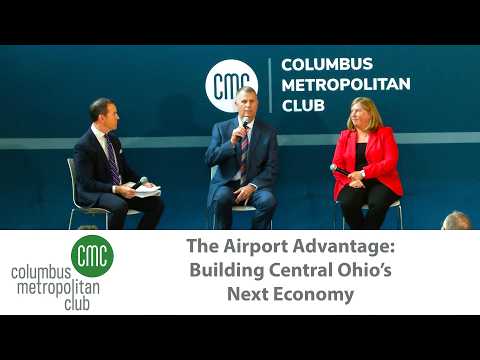
Darren Griffin, president and CEO of the Columbus Regional Airport Authority, and Deborah Shearer, senior vice president of global trade and investment with 1 Columbus, on Wednesday described plans for a roughly $2 billion John Glenn International terminal intended to expand capacity and modernize operations.
"This conversation and this effort began in the Columbus Regional Airport Authority more than 10 years ago," Griffin said, calling a full terminal rebuild “incredibly complicated” but an opportunity to simplify passenger flow and improve back-of-house systems. He said the project will increase contact gates from 29 to 36, include two international gates with an integrated U.S. Customs and Border Protection facility, and add about 5,300 parking spaces.
Shearer said visiting company executives treat the airport as the region’s front door and often factor routes and ease of travel into location decisions. "It needs to represent a welcoming place," she said, adding that direct international connections can be an important decision point for businesses evaluating Columbus.
Both panelists stressed that airlines make route decisions based on detailed profitability analyses. "Every airline looks at an aircraft as a movable asset," Griffin said, and the airport’s task is to present data-driven "business cases" — passenger origination, market growth and paid premium demand — that persuade carriers to add nonstop or transatlantic flights. Shearer said One Columbus works with private-sector partners to pitch carriers about additional service.
On technology and security, Griffin emphasized the build is an opportunity to install modern customer-facing systems and improve back-of-house operations such as baggage screening. He said the airport is seeking to put the best available inline baggage screening and checkpoint technology into the new terminal in coordination with TSA and federal partners.
The authority expects the terminal work to be largely financed through borrowing that is supported by airline rents in the new facility; Griffin said about $1.67 billion of the project cost will be financed in that way. He also said the project will enable redevelopment of land where the existing terminal now sits, creating additional regional economic opportunities.
Panelists discussed multimodal access: the project will include a ground transportation center designed for COTA buses, rental-car access and passenger drop-offs, and officials said the airport is open to future rail connections though FAA requirements and funding complicate direct rail links.
On jobs, Griffin said the airport authority employs about 385 people and that thousands more work for carriers and businesses operating on airport campuses; he said colleges and universities in the region supply needed talent. On EV charging, Griffin said the new 5,000-space parking deck will include about 100 EV chargers concentrated on the top level for safety and access reasons.
During audience questions, panelists reiterated safety is the top priority, noted that AI and automation are being applied to improve efficiency rather than replace critical human roles ("in the aircraft, there's always going to be two pilots"), and confirmed the authority is still discussing options for the historic 1929 terminal with museum stakeholders.
Griffin and Shearer urged local travelers and businesses to use nonstop flights as they become available to help sustain service. The forum was hosted by the Columbus Metro Club at the National Veterans Memorial and Museum and livestreamed by the Columbus Dispatch.