Get Full Government Meeting Transcripts, Videos, & Alerts Forever!
Get email alerts on the Industrial Zoning topic
No spam. Unsubscribe anytime.
Horace commission asks staff to draft ordinance to clarify rules for concrete and asphalt batch plants
Summary
Commission directed staff to prepare a draft ordinance to explicitly add concrete and asphalt batch manufacturing to the city’s sand‑and‑gravel regulations and return with a noticed public hearing; commissioners debated separation distances (500 ft vs 1,000 ft/quarter‑mile) and measurement from use vs property line.
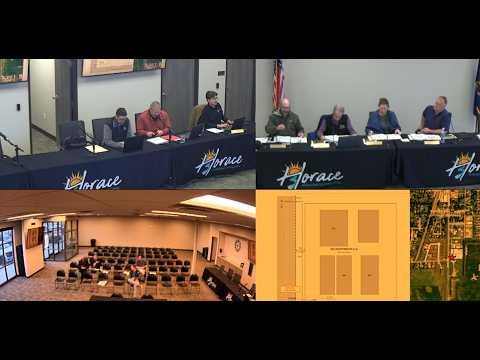
At its April 14 meeting, the Horace Planning and Zoning Commission directed city staff to prepare a draft ordinance to clarify whether concrete and asphalt batch manufacturing are explicitly regulated under the city’s sand‑and‑gravel rules.
"Our code is silent if you're searching for the words asphalt or concrete plant," Nathaniel, city staff, told commissioners. He proposed adding concrete and asphalt batch manufacturing to the definition of sand‑and‑gravel operations and bringing that language back for public notice and hearing.
Nathaniel outlined the current regulatory path: a proposed site would need a rezoning to general industrial (where allowed), plus a conditional use permit that requires reclamation guarantees, compatibility findings for vegetation and groundwater, and the city’s authority to terminate operations for noncompliance. He noted the code currently lists minimum separation distances of 500 feet from residential uses and 300 feet from nonresidential uses for similar operations.
Commission debate centered on whether the separation distance should remain at 500 feet, be increased to 1,000 feet, or be set at a quarter‑mile (about 1,250 feet), and on whether the measurement should start from a property line or from the active use (for example, the location of material bunkers). One commissioner recommended spelling out the definition while leaving a conditional use path in place so the city could review applications case‑by‑case; another suggested a larger distance buffer around residential areas to protect neighborhoods.
By motion, the commission instructed staff and consultants to prepare a draft ordinance reflecting the discussion and return it for formal notice and a public hearing. Staff will draft language clarifying definitions and consider options to define how separation distances are measured.
Next steps: staff will prepare the draft ordinance and return it to the commission for public notice and hearing at a later date; no ordinance change was adopted at the April 14 meeting.