Get Full Government Meeting Transcripts, Videos, & Alerts Forever!
Get email alerts on the Housing Incentives topic
No spam. Unsubscribe anytime.
Eugene council adopts ordinance creating two 10-year tax-exemption pilot programs to spur housing production
Summary
The Eugene City Council voted 8–0 on July 15 to adopt an ordinance authorizing two 10-year property-tax-exemption pilot programs — one for moderate-income housing near transit and one for housing in commercial centers — with a pilot period through 2032 and a two-year check-in.
The Eugene City Council on July 15, 2026, voted unanimously to adopt an ordinance creating two 10-year property-tax-exemption pilot programs intended to make new housing projects more financially feasible.
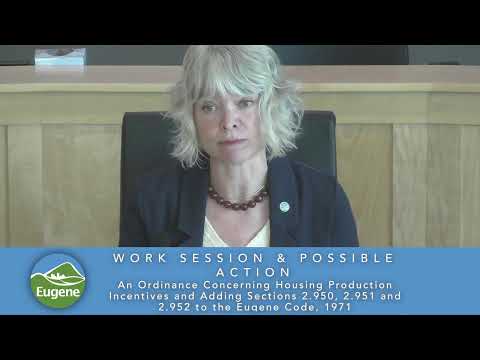
The ordinance, moved by Council President Leach, adds sections 2.95, 2.951 and 2.952 to the Eugene Code 1971 to establish: (1) a moderate-income housing tax exemption for projects near fixed transit routes that commit to long-term moderate-income affordability, and (2) a commercial-centers tax exemption intended to encourage mixed-use and market-rate housing in downtown and core commercial centers. The council recorded an 8–0 vote in favor.
Staff said the incentives are enabled by state statute for transit-supportive multiunit housing and are proposed as pilots through 2032 with an update planned within two years. Amanda D'Souza, who led the presentation, said the programs are designed to address the city's housing shortfall identified in the state's 2026 Oregon housing needs analysis (ONA). "Using the 2026 ONA, we know Eugene needs 26,000 new dwelling units in the next 20 years," D'Souza said. "That means producing up to 1,600 units per year compared with our recent average of about 950 per year."
Key program features
- Eligible projects must be completed by 2032 and the tax exemption applies only to new improvements; properties continue to pay tax on land value during the exemption. - Minimum project size: 4 units total and a minimum net density of 25 units per acre. - Geographic filters: moderate-income program applies to properties with at least 80% of their area inside a quarter-mile transit buffer; staff excluded properties within 300 feet of E2/I2 zones or 500 feet of I3 zones to avoid incentivizing housing adjacent to certain industrial air uses. - Application process: mirrors accelerated MUPTI parameters with a 60-day turnaround, council priority agenda consideration, urban design review and seven public-benefit criteria. - Commercial-center exemption has no income restriction but requires a public-benefit finding; council retains discretion to define and approve public benefits case-by-case.
Staff also noted five safeguards: ineligible student housing (a restriction that has existed since 2015), map-based filters to limit industrial adjacency, project-size minimums, urban-design review requirements for pedestrian-friendly outcomes, and the proposed two-year check-in to reassess program parameters.
Councilors probed multiple topics during discussion. Councilor Clark asked what state law requires if Eugene fails to meet housing production targets; Assistant City Attorney Lauren Summers said the Housing Accountability and Production Office (HAPO) would work with cities to provide assistance and resources and that the agency's authorities and enforcement practices are still being established. "There are deadlines and the city would be assigned to work with the HAPO if progress is not made," Summers said.
At the June 15 public hearing on the draft ordinance, staff reported four speakers testified (three in favor, one opposed); the opposing speaker argued against offering property-tax exemptions to individuals and raised concerns about student housing along Franklin. Staff responded that student housing has been ineligible for tax exemptions since 2015.
Next steps
The city will implement the ordinance as a pilot and return within two years to report on outcomes and any recommended adjustments. Projects seeking the exemption must still apply and obtain council approval under the program's application process.