Get Full Government Meeting Transcripts, Videos, & Alerts Forever!
Get email alerts on the Redevelopment Codes topic
No spam. Unsubscribe anytime.
Laramie planners review Unified Development Code, discuss easing middle-tier requirements to encourage incremental improvements
Summary
At a July 14 work session, planning Director Derek walked the Laramie City Council through the Unified Development Code, explaining Type 1/2/3 site plans, parking-lot reconstruction thresholds, and flexibility tools staff use; public commenters urged simplification and financial support for property repairs.
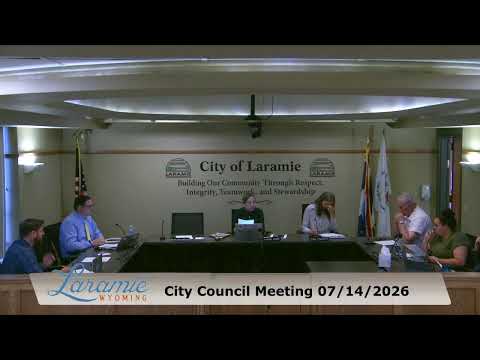
Planning Director Derek briefed the Laramie City Council at a July 14 work session on how the city’s Unified Development Code (UDC) governs redevelopment projects and when sites must be brought into full compliance.
Derek said the UDC replaced a fragmented pre-2010 regime and created a formal site-plan process to give staff and property owners clearer rules. He described a three-tiered system for site plans: Type 1 for small, localized changes, Type 2 for moderate updates that often require perimeter landscaping or drainage fixes, and Type 3 when projects must bring the whole site into conformance.
“The council directed us that properties in this community should be required to improve their site when expansion and changes occur,” Derek said, explaining the philosophical shift behind the 2010 code rewrite. He told council that the code includes thresholds that trigger Type 3 reviews — for example, an increase in building stories, a building enlargement of 20% or 20,000 square feet, or more than 2,000 square feet of added impervious surface (stormwater is the driver for that metric).
Derek laid out how parking-lot work is handled: routine repairs such as crack sealing and overlays are exempt; full reconstruction (when asphalt is taken down to the base) is measured by area replaced. If reconstruction replaces less than 25% of a lot it is exempt; replacing 25%–50% typically triggers landscaping adjacent to the right of way; 50%–75% triggers more extensive landscaping; and reconstruction over 75% generally requires full-site compliance. He also described an administrative option that allows staff to authorize up to a 20% loss of parking spaces to help properties avoid triggering full reconstruction requirements.
To give projects flexibility, staff rely on three mechanisms: alternative equivalent compliance — where applicants propose an alternate method that achieves the code’s intent; minor administrative modification — a staff-reviewed numeric reduction with notice to nearby owners; and variances, which require a higher showing and go to a board of adjustment or appeals. Derek said the alternative-equivalent approach is commonly used for landscaping placement and unique parking arrangements.
Council members pressed staff about outreach and how property owners find out about these rules. Derek said the planning office offers free pre-application meetings, partners with the Laramie Chamber Business Alliance, and posts guidance on the city website. He said staff frequently meet prospective developers and can usually tell early whether a project will land in Type 1, 2 or 3.
Councilors also asked about enforcement and whether there is any formal grace period for owners who buy properties and later discover code obligations. Derek said the code does not prescribe a universal grace period; instead, staff often work with owners to find staged solutions, use bonding when appropriate, or provide time to file applications — but life-safety requirements cannot be deferred.
On the Type 2 category, Derek told council staff and the Chamber have identified that the middle tier is not functioning as intended; he said staff will return with proposals to shift some projects into Type 2 so sites can improve incrementally instead of facing an all-or-nothing Type 3 requirement. Possible adjustments under consideration include changing thresholds for impervious surface or refining parking-related triggers.
In public comment, Bridal Glass urged the council to simplify the UDC, calling it “a monster” with excessive granularity that deters investment and maintenance. Linda Devine (online) thanked staff for the presentation and suggested exploring grant or assistance programs to help longtime property owners afford repairs so blighted or deteriorated sites do not linger.
Derek noted the developer survey on which staff have been collecting comments is closed and that staff plan additional outreach with the development community. He emphasized that pre-application meetings are free and that staff aim to steer applicants early toward the correct process.
No code amendments were adopted at the work session; Derek said staff will bring forward drafted changes for council consideration after further outreach and analysis. The council also added two items to the upcoming agenda — a consent-item letter opposing larger interstate trucks and a furniture purchase contract for City Hall annex — and adjourned the work session without votes on code changes.
Sources: presentation and Q&A at the July 14 Laramie City Council work session; public comments at the meeting.