Get Full Government Meeting Transcripts, Videos, & Alerts Forever!
Get email alerts on the Land Bank topic
No spam. Unsubscribe anytime.
Will County board hears proposal for county land bank; $1 million ARPA seed and municipal veto protections debated
Summary
Will County officials and outside experts outlined a plan to create a county-focused land bank to acquire and redevelop vacant and abandoned properties, backed by a proposed $1 million ARPA seed. Board members pressed for stronger IGA guardrails on liability, municipal veto authority and transparency; no final vote was taken.
Will County Board members spent Tuesday’s Committee of the Whole meeting weighing whether to create a county land bank to reclaim vacant and abandoned properties and return them to productive use.
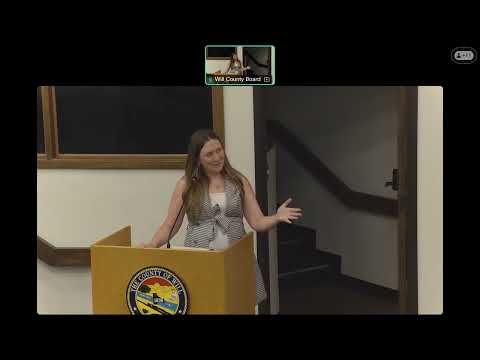
Kayla Sorensen, vice president of external affairs for the Will County Center for Economic Development, told the board she was speaking on behalf of CEO Doug Pryor and that the CED “fully support[s]” the initiative. Hugh O’Hara of the Will County Governmental League gave the presentation’s overview, defining a land bank as an entity that “acquire[s], clear[s] up tax and title issues, tries to stabilize and get the sites ready for resale,” and stressing it “doesn’t have things like eminent domain.”
The proposal on the table calls for the county to enable a land bank through an intergovernmental agreement (IGA) and to seed that entity with $1,000,000 in ARPA funds housed initially at the CED. O’Hara described the startup as deliberate and small-scale: “We want to crawl before we get to walking,” he said, noting the intent that the fund become a revolving pool replenished by sales and future grants.
Why it matters: presenters said land banks can help address public-health, safety and neighborhood-stability problems tied to blighted properties and can reassemble fragmented parcels that private market actors won’t touch. University Park Mayor Joe Bridal described his municipality’s experience: when he took office the village had “over 200 boarded up and abandoned properties,” and now has “less than 20,” a change he said produced renewed development and higher tax receipts.
Board members pressed presenters on several practical and policy issues. Members sought clarity on which parcels would be targeted; O’Hara and county staff distinguished the roughly 116 tax-foreclosure parcels that have been through surplus cycles from a broader CMAP estimate of about 1,500 vacant or abandoned parcels countywide. Members also questioned whether the land bank could acquire occupied homes (it cannot force sales) and how acquisitions would affect other taxing districts.
Several members demanded explicit guardrails before endorsing formation. Concerns included whether the county could ever be held liable or required to supply additional taxpayer funds; how conflicts of interest and procurement would be enforced; how often the land bank board would meet; and whether municipalities would retain a role in approving projects inside or near their borders. O’Hara and CED staff repeatedly said the land bank would be a separate governmental entity with its own board and auditing requirements, and that many operating details—procurement policies, acquisition and disposition rules, and conflict-of-interest enforcement—would be set by that board.
On the question of municipal control, O’Hara and legal staff described draft IGA language that would give local jurisdictions substantial voice and suggested including explicit authority for municipal approval or veto for actions within municipal corporate limits (and potential extension to a municipality’s planning area). Several members said they wanted a mile-and-a-half planning-area protection or similarly explicit language added to the IGA to preserve local planning prerogatives.
Funding and timing were also central. Board members queried how much ARPA funding the CED had received in total, how prior ARPA dollars had been used, and whether the $1,000,000 remained available and in interest-bearing accounts. County staff said CED holds ARPA allocations and confirmed the $1,000,000 was the proposal for the land bank; they also warned of ARPA spending deadlines that make timing an operational concern.
Next steps: legal counsel and staff described the agenda item as a two-part process: the county can authorize formation of a land bank and allocate the seed funding while the IGA and related documents are finalized through negotiation with potential municipal partners. No final vote creating the land bank took place at Tuesday’s meeting; several members and staff endorsed moving forward on the formation concept contingent on a revised IGA that addresses liability, transparency, municipal approval, audit and meeting-frequency concerns. The committee adjourned after the discussion.
The board will consider the matter again as the IGA is drafted and redlined; staff and county attorneys indicated municipalities will be asked to join via the IGA and that the board could amend or postpone final approval on the floor if outstanding issues remain.