Get Full Government Meeting Transcripts, Videos, & Alerts Forever!
Get email alerts on the Teacher Salaries topic
No spam. Unsubscribe anytime.
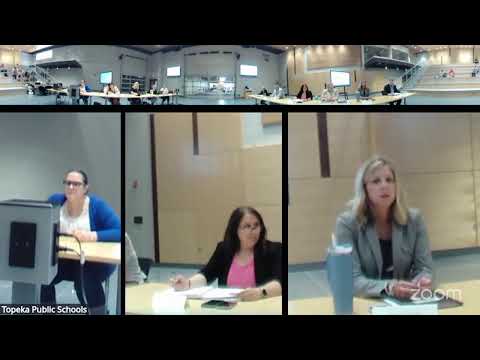
Topeka Public Schools negotiators debate a 3% across‑the‑board raise as enrollment falls
Summary
Bargaining session on Topeka Public Schools salary proposals centered on a district offer that applies a 3.00% minimum across every salary cell (rising to about 3.328% in some cells), concerns about rising health insurance costs, a reported 275 FTE enrollment decline, and disagreement over duty days and professional column movement.
Topeka Public Schools negotiators spent a bargaining session hashing out a district salary package that would apply a percentage raise across the teacher salary schedule, with a stated minimum of 3% and cell‑specific increases up to about 3.328%.
An agency official summarized the district packet and the numbers presented to negotiators, saying the proposal ‘‘is a minimum of 3% on this entire scale, to a maximum of 3.328% increase for all staff’’ and that the district also proposed an increased district contribution for health insurance that produces an estimated total additional compensation ‘‘between $2,316.22 up to … $3,374.14’’ on the high end. The official noted health insurance costs had increased 11.8% this year and that a 14.8% cap on the district’s rate applies next year, limiting options for further insurance‑related incentives.
A negotiator for the employee side reiterated that the bargaining unit had spent the prior day working on a counterproposal and emphasized the group’s interest in moving to a percentage raise rather than a flat dollar amount: ‘‘we put together, a package … that encompasses … the 3 percent salary increase’’ and said the team ‘‘worked until 04:00 yesterday’’ to prepare it. That negotiator also said they do not agree that the duty‑days/calendar question should be handed off to a committee and want to resolve the duty‑year issue in bargaining.
Negotiators pressed for technical clarification about how the percentage was calculated per salary cell. The district explained the per‑step percentage is derived by taking the proposed step amount difference divided by the prior‑year step amount, and confirmed that step movement remains part of the calculation so eligible employees would continue to progress steps in addition to receiving the percentage overlay.
Participants raised affordability concerns. One meeting participant relayed feedback from the bargaining unit that ‘‘teachers are needing to make some really tough decisions because they just can't afford to be a teacher anymore.’’ Another participant said summer professional development credit hours available through the district do not allow employees stuck in the ‘‘gray’’ column to move into a higher column, a restriction that staff said other districts do not impose.
District staff explained funding pressures tied to enrollment. An agency official said the district expects an adjusted full‑time‑equivalent (FTE) decline of 275 students from the prior year and that audited student counts (taken on the Sept. 20 count day and published in early December) feed into the state funding formula. ‘‘That 275 … is the adjusted … FTE amount that we had to feed into the funding formula this year,’’ the official said, and offered to provide the KFC public recap form with the precise numbers.
A negotiator raised the district’s internal compensation decisions in comparison to an administrator contract approved in March that included a roughly $12,650 (about 4.96%) raise, saying the disparity made it harder for employees to accept the current package. The district representatives said administrator raises are governed by different processes and that the presented offer reflects what leadership judged sustainable for all employee groups within the budget.
There were no formal motions or votes recorded in the transcript. Negotiators agreed to caucus, take a lunch break, and reconvene; one side said it did not yet have a counterproposal and asked for time to develop another offer. The meeting paused so parties could consult calendars and exchange possible follow‑up dates by email.
Next procedural step: parties planned to reconvene after the break to continue bargaining and to share any updated counterproposal or board direction.