Get Full Government Meeting Transcripts, Videos, & Alerts Forever!
Get email alerts on the Alpr Flock topic
No spam. Unsubscribe anytime.
Residents urge removal of Flock cameras as Burbank Police Commission opens technology review
Summary
Dozens of Burbank residents pressed the Police Commission to cancel the city’s Flock ALPR contract, citing privacy, data-security and misidentification concerns; commissioners said they will study data storage, procurement and oversight and carried the item to the next meeting for further recommendations.
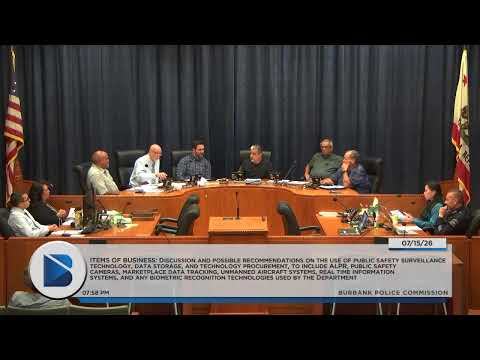
Dozens of residents and callers urged the City of Burbank Police Commission on July 15 to end the city’s contract with Flock, the private automatic license-plate–reader (ALPR) vendor, and to rethink the department’s use of surveillance technology.
"They make me feel less safe," said Max Meserve, a lifelong Burbank resident, criticizing Flock’s cameras and urging the commission to move with "alacrity" to remove them. Other speakers cited large monthly plate counts, alleged ex-employee access to databases, errors that can lead to false alerts and arrests, and the risk that vendor-held data could be accessed by outside agencies. Amber, a resident who identified herself during public comment, framed the debate as constitutional, citing Carpenter v. United States and concerns about the chilling effects of searchable surveillance databases.
The public comment period featured a chorus of similar concerns: calls to cancel the contract even if doing so required paying termination fees; requests for independent audits; and requests that the commission and city be transparent about what data is collected, who can query it and what controls are in place. Alex Magullian cited public-records figures he said show Burbank pays roughly $250,000 annually and that the system’s follow-up and arrest rates are a small fraction of total reads; Daniel Negrete of the Student Civil Liberties Union urged review of state and federal privacy authorities and SB 34, which regulates ALPR systems.
Supporters of continued use also addressed the commission. David Donahue, who identified himself as a homeowner and business owner, described Flock as “an indispensable tool,” citing prosecutions and arrests and arguing the system is affordable relative to the alternative of substantially more officers.
In their responses commissioners struck a cautious, investigatory tone. Commissioner Narbeh and others thanked speakers for the turnout and recommended examining the Los Angeles Police Department review of its ALPR arrangements. Commissioner Paul noted the department’s transparency portal that allows public queries of recent ALPR use and urged residents to review the available logs. Commissioner James led a commission presentation laying out the review areas the commission intends to explore: surveillance technologies generally, a policy inventory, data storage practices (local vs. cloud), procurement processes and ALPR-specific issues.
Assistant CIO Garenis Khanian told the commission that the city maintains on-premises servers for some data but uses FedRAMP-certified cloud services (and CJIS-compliant controls) for several vendor systems such as Axon/evidence.com. Commissioners discussed the legal mechanics by which federal authorities may seek vendor-held data (SCA subpoenas and nondisclosure orders) and emphasized the tradeoffs between local control and cloud-based redundancy and cost.
Commissioners also discussed private ALPR deployment and third-party integrations such as registries and real-time camera networks (Axon/Fusus), unmanned aircraft systems and the county’s LACRIS facial-recognition system accessed via mutual aid. Several commissioners recommended improved procurement transparency, stronger auditing and oversight mechanisms, and considering local data-management alternatives or dedicated local expertise to evaluate analytics and data-sharing practices.
No final policy actions were taken. The commission voted to carry further discussion and any formal recommendations to its next meeting so staff and the department can provide additional information; that motion passed by roll call. The meeting record shows commissioners asked for more specific audit requests and for the commission to coordinate future public engagement and staff briefings.
What happens next: the commission will continue the item at its next scheduled meeting; staff and the department were asked to provide follow-up information about contracts, audit logs, storage locations and options for local data management. The meeting adjourned after the motion to carry the item.