Get Full Government Meeting Transcripts, Videos, & Alerts Forever!
Get email alerts on the Power Lane County topic
No spam. Unsubscribe anytime.
Lane County releases electric‑grid handbook and selects future‑demand analysis for DOE technical assistance project
Summary
Lane County and partners released the Power Lane County Electric Grid Handbook and selected a future demand growth analysis (with resilience valuation and critical‑facilities assessment) as the countywide DOE technical‑assistance project; staff and national‑lab partners highlighted transmission vulnerabilities, wildfire risks and limited local generation.
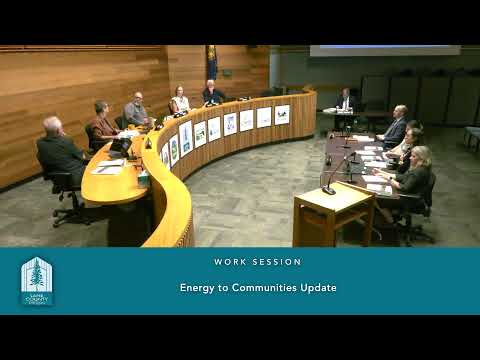
Lane County officials on July 14 presented findings from the DOE‑funded Power Lane County technical assistance project and distributed a 200‑plus page Electric Grid Handbook that maps local utilities, vulnerabilities and opportunities to improve affordability, reliability and resilience.
Steve Adams, county policy director, said the three‑year technical assistance award — carried out with the Springfield Utility Board, Emerald People’s Utility District and national laboratories — provides deep technical analysis to help the county understand its electric grid and identify projects with countywide benefit.
Rachel Dorfman, senior planner with the Lane Council of Governments, told commissioners the handbook establishes a baseline of who serves power in Lane County (10 utilities, most purchases tied to the Bonneville Power Administration) and documents gaps such as limited local generation and lack of black‑start capability. ‘‘The handbook is now publicly available,’’ Dorfman said. She said the project’s goals include improving reliability, affordability and resilience and fostering collaboration among local governments and utilities.
Kristen Lee, a member of the county policy team, summarized key takeaways: because roughly 75% of BPA’s supply is hydroelectric, consumer‑owned utilities in the county have historically had lower rates than the national average, but the handbook flags east–west transmission vulnerabilities and several areas with only one medium‑voltage line, raising the risk of outages. The presentation singled out four hazards likely to produce major impacts: wildfire, winter storms, extreme heat and earthquakes.
National‑laboratory partners and Ally Truworthy (Pacific Northwest National Laboratory) discussed technical options. Truworthy said technologies such as sectionalizing, islanding and microgrids can allow groups of facilities to be isolated and kept powered, but ‘‘it will always be very expensive to be... very surgical building by building.’’ The county team recommended Option 3 — a future demand growth analysis combined with resilience valuation and critical‑facilities assessment — as the countywide project to pursue in the second half of the grant.
Commissioners asked whether the study considered large proposed loads (one commissioner referenced a major data‑center project); staff said the consumer‑owned utilities being studied do not serve every potential large load and that regional resource‑adequacy studies are used for near‑term planning, while the county project will help improve local forecasting and coordination with utilities.
Next steps include laboratory technical analyses, a July 21 presentation to the Southern Willamette Valley Innovation Corridor, additional stakeholder engagements later in the year, and a project completion target of January 2028.
What happens next: the county will pursue the recommended future‑demand analysis and continue stakeholder outreach and technical work with the national laboratories and utility partners.